

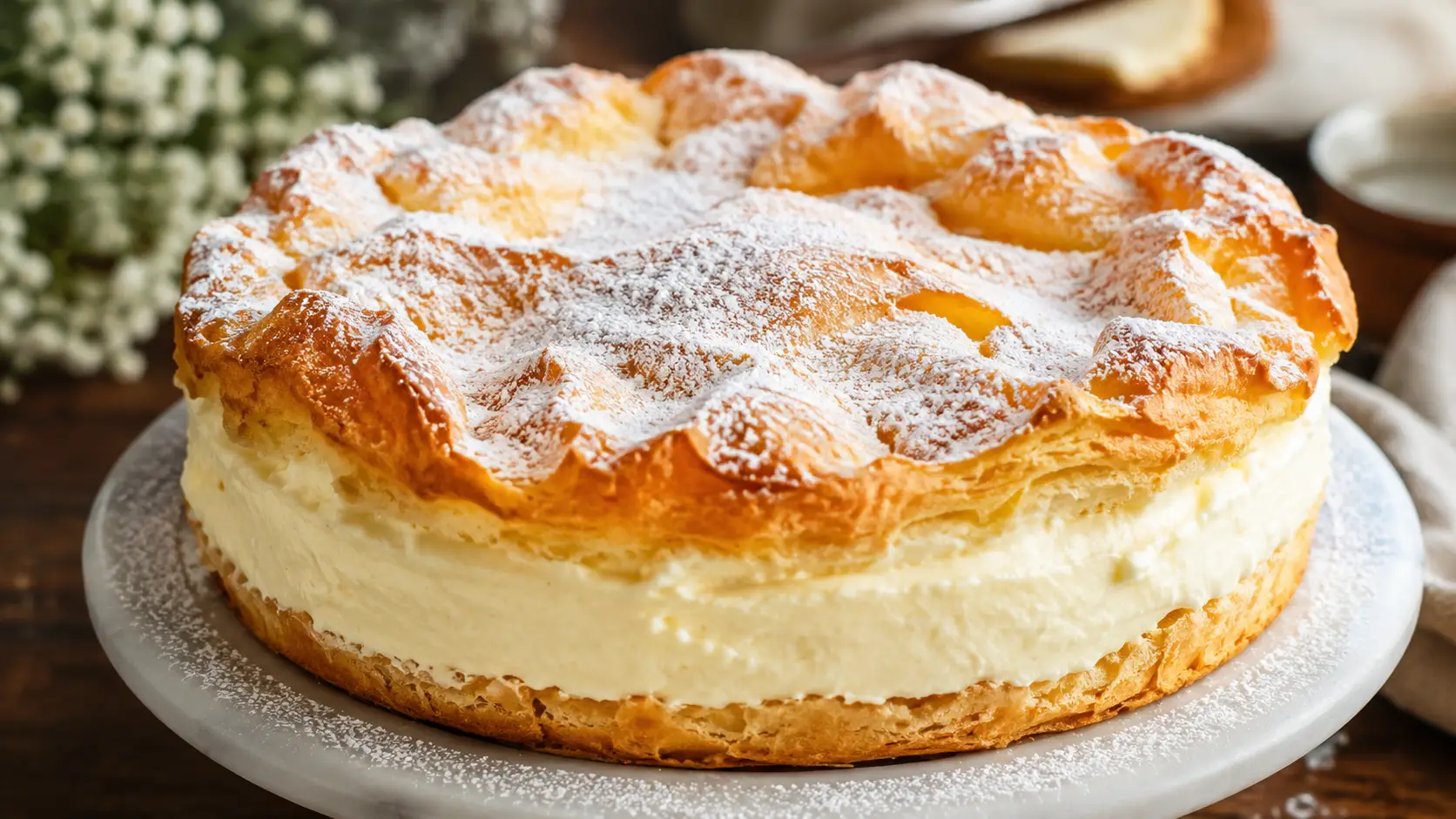
Crisp Choux Waves • Vanilla Butter Cream • A European Classic Worth Every Hour
Nora Piket has baked her way through a great many European classics for AstroRecipes’ Seasonal Joy collection — but few have the kind of quiet, unhurried magic that Karpatka carries. This is a cake that does not shout. It does not dazzle with frosting flowers or mirrored glazes. It simply sits on the table, dusted in powdered snow, rugged and crinkled on top like the mountain range it was named after, and waits patiently for someone to cut into it. And then, the moment that knife passes through the crisp choux waves and hits the thick, silky vanilla cream underneath — everything becomes clear. This is the cake people remember.
Karpatka — pronounced kar-PAT-ka — takes its name from the Carpathian Mountains, the arc of forested peaks that sweep across southern Poland and into Slovakia, Ukraine, and Romania. The two baked choux pastry layers are meant to suggest those jagged, snow-dusted summits. The cream between them is the valley: soft, generous, and impossible to rush. It is Poland’s answer to every occasion that calls for something special — Christmas tables, name-day celebrations, Easter spreads, and the kind of Sunday afternoon visit where the good china comes out.
It is not a quick cake. But every minute of the chilling time is earned by a result that is genuinely, unambiguously extraordinary. Let’s bake it properly.
Table of Contents
This Cake Looks Like a Disaster… Until the First Slice Reveals the Secret 🏔️🍰
Wild Polish Cream Cake With a Hidden Vanilla Center
Why Karpatka Belongs in Your Baking Repertoire
- The textural contrast is unlike anything else — crisp, slightly hollow choux pastry on the outside; thick, cold, silky cream on the inside. Every bite has both.
- It is a celebration cake that requires no specialist equipment — no stand mixer is essential, no thermometer is needed, no piping bag is required.
- The flavour is elegant and restrained: real vanilla, real butter, real custard. Nothing synthetic. Nothing overwhelming.
- It keeps beautifully in the refrigerator for 2 to 3 days, which makes it an ideal make-ahead dessert for gatherings.
- It looks like something from a Polish bakery window — impressive and deeply seasonal — but the technique is achievable for any confident home baker.
- It is the kind of dessert that travels through generations. Once someone in your family learns to make it, it gets requested forever.
The Story Behind the Mountains
Poland has a long and proud tradition of choux pastry desserts — a culinary inheritance shaped by French influence in the royal courts of the 16th century, when the Italian-born Queen Bona Sforza brought new culinary ideas to the Polish kitchen. Choux pastry, called parzone ciasto in Polish, became the foundation for a range of beloved baked goods. But Karpatka is the one that caught the landscape’s imagination.
The name is not just poetic — it is descriptive. When you spread the choux dough onto a baking sheet and create those waves with a spatula before it goes into the oven, the baked result genuinely looks like a relief map of the Tatry or Bieszczady ranges. The peaks rise, the valleys dip, and the whole thing turns a deep golden brown that looks as though it has been warming in mountain sunlight.
In Poland, Karpatka is one of the most beloved cakes at family celebrations. It appears at Easter alongside mazurek and babka. It shows up at Christmas alongside piernik and makowiec. It is the cake that grandmothers make for grandchildren, that mothers teach daughters, that gets written on index cards and tucked into the back of recipe binders for safe-keeping. To eat it is to understand something about Polish cooking — its honesty, its generosity, its complete lack of interest in anything superficial.
Understanding the Two Components
The Choux Dough (Ciasto Parzone)
Choux pastry — the same dough used for profiteroles and éclairs — works on a simple principle: water and butter are brought to a boil, flour is added all at once to create a roux, and then eggs are incorporated one at a time. The steam trapped inside the dough during baking creates hollow, light pockets. For Karpatka, the dough is spread into flat sheets and deliberately given peaks and waves rather than being piped into individual forms. These peaks puff and crisp in the oven, creating the mountain silhouette that defines the cake.
The key to successful choux is flour cooked long enough in the roux stage, and eggs added when the dough has cooled slightly — never to a hot mixture, or the eggs will scramble. The final dough should be smooth, glossy, thick, and fall from a spoon in a slow V-shape.
The Vanilla Butter Cream (Krem Budyniowy)
This is not a buttercream in the American sense. It is something better — a custard-based butter cream, made by cooking a proper vanilla custard (budyń) from scratch and then beating room-temperature butter into it, spoonful by spoonful, until you have something light, airy, and deeply vanilla-scented. The custard must be completely cold before it meets the butter, or the fat will split and the cream will be greasy rather than silky.
The result is richer than whipped cream, lighter than ganache, and more flavourful than either. It holds its shape perfectly when sliced, and it softens just enough as it comes to room temperature to feel luxurious on the palate.
Ingredients
Serves 8–10 | Prep: 30 min | Bake: 35 min | Chill: 4 hours (overnight preferred)
For the Choux Dough (makes 2 layers):
- 200 ml water (about ¾ cup)
- 100 g unsalted butter, cubed
- 1 teaspoon granulated sugar
- A pinch of fine salt
- 140 g plain flour (about 1 cup + 1 tablespoon), sifted
- 4 medium eggs (or 3 large), at room temperature
For the Vanilla Butter Cream:
- 2½ cups whole milk (600 ml)
- 5 tablespoons granulated sugar
- 2½ tablespoons cornstarch (cornflour)
- 1 egg yolk
- 1 packet vanilla sugar (5 g) — or 1 teaspoon pure vanilla extract
- 150 g unsalted butter, at room temperature (very important — it must be truly soft)
To finish:
- Powdered (icing) sugar, for generous dusting
- Optional: fresh strawberries or raspberries between layers
- Optional: a few drops of vanilla extract added to the cream for extra depth
Step-by-Step Instructions
Stage 1 — Make the Custard Base (do this first)
In a medium saucepan, whisk together the cold milk, sugar, cornstarch, egg yolk, and vanilla sugar until completely smooth — no lumps. This is much easier to do before the heat goes on, so take your time here. Place over medium heat and cook, whisking constantly and making sure to reach the edges and corners of the pan, until the mixture thickens into a proper custard. This will take 6 to 8 minutes. You will feel the resistance in the whisk increase suddenly as it thickens — keep stirring for another full minute after this point.
Remove from heat. Immediately press a sheet of plastic wrap directly onto the surface of the custard — this prevents a skin from forming. Allow to cool to room temperature, then refrigerate for at least 2 hours or until completely cold. Do not rush this stage. Warm custard added to butter creates a broken, greasy cream.
Stage 2 — Make the Choux Dough
Preheat your oven to 180°C / 350°F. Line two identical baking trays — approximately 20×30 cm (8×12 inches) — with parchment paper. If you only have one tray this size, bake in two batches.
Combine the water, butter, sugar, and salt in a medium saucepan. Bring to a full rolling boil over medium-high heat, stirring to melt the butter. The moment it reaches a full boil, remove from heat and add all the sifted flour in one go. Stir immediately and vigorously with a wooden spoon until the mixture comes together into a smooth ball and pulls cleanly away from the sides of the pan. Return to medium heat and continue stirring for 2 to 3 minutes — this dries the dough slightly and cooks out any raw flour taste.
Transfer the dough to a large bowl and let it cool for 10 minutes — it should feel warm but not hot. This step is critical: if you add eggs to dough that is too hot, they will partially cook and the texture will be ruined.
Stage 3 — Add the Eggs
Add the eggs one at a time, beating vigorously after each addition until fully incorporated before adding the next. This can be done with a wooden spoon, a hand mixer, or a stand mixer with a paddle attachment. After all eggs are added, the dough should be smooth, glossy, and slightly sticky — it should fall from the spoon in a slow, reluctant ribbon. If it seems too stiff, beat in an additional tablespoon of beaten egg.
Stage 4 — Bake the Layers
Divide the choux dough into two equal portions. Spread each portion onto a prepared baking tray — aim for an even layer of approximately 1–1.5 cm thickness. Now, using the back of a wet spoon or an offset spatula, create irregular peaks and waves across the surface. Do not try to make these neat. The rougher and more mountain-like, the better. This is both the aesthetic and the structural appeal of Karpatka.
Bake at 180°C / 350°F for 35 minutes. The most important rule in choux baking: do not open the oven door during baking. Not at 20 minutes to check, not at 25 minutes because you’re curious. The steam inside the dough is what creates the structure, and a rush of cold air will collapse everything. Wait the full 35 minutes. The layers should emerge deep golden brown, firm to the touch, and hollow-sounding when tapped.
Allow both layers to cool completely on a wire rack. Do not assemble until both pastry and cream are fully cold.
Stage 5 — Finish the Butter Cream
Remove the cold custard from the refrigerator. Beat the room-temperature butter in a large bowl with an electric mixer on medium-high speed for 3 to 4 minutes until it is pale, light, and very fluffy. This step matters — the butter needs to be aerated before the custard is added.
Add the cold custard to the butter one heaped tablespoon at a time, mixing on medium speed between each addition and ensuring it is fully incorporated before adding more. Work slowly and patiently. Rushing this — adding too much custard at once or adding it warm — is the most common cause of a split cream. If the cream does look curdled at any point, gently warm the bowl briefly over a pan of warm water and continue mixing — it will usually come back together.
The finished cream should be very thick, pale, and cloud-like, with a clean vanilla scent. Taste and adjust — a few drops of vanilla extract can be added here if you want a deeper flavour.
Stage 6 — Assemble
Place one choux layer, flat-side down, on your serving plate or board. Spoon the vanilla butter cream onto it and spread generously and evenly, pressing the cream gently into the peaks and valleys of the pastry surface. If using berries, scatter them across the cream now, pressing gently so they sit secure. The cream layer should be substantial — this is not a cake for rationing. Place the second choux layer on top, pressing very gently to anchor it.
Stage 7 — Chill and Finish
Refrigerate the assembled Karpatka for a minimum of 3 to 4 hours. Overnight is significantly better. The chill time allows the cream to firm fully, the moisture to soften the choux layers slightly from within, and the flavours to settle into each other. The patience is entirely justified.
Just before serving, dust the top generously with powdered sugar. This is not optional — the snow-white dusting is the final visual gesture that completes the mountain image. Use a fine sieve for an even, delicate coat.
Baker’s Notes — What Makes the Difference
Temperature is everything. The dough must be warm but not hot when the eggs go in. The custard must be cold when it meets the butter. These two temperatures are non-negotiable and the most common source of failure when they are ignored.
Sift the flour. Lumps in the flour create lumps in the dough that never fully cook out. A 30-second sift before you start is worth it.
Never open the oven during baking. The steam inside the choux dough is structurally load-bearing. Cold air collapses it instantly. Use the oven light, not the door.
Room-temperature butter for the cream. Not slightly cold. Not just out of the fridge. The butter should yield when pressed — soft enough to leave a fingerprint easily. Cold butter will not aerate properly and the cream will be heavy.
Add the custard slowly. One tablespoon at a time is the professional approach. The emulsification between butter fat and custard liquid is temperamental. Give it time and it will reward you.
Overnight chilling changes the cake. A 4-hour chill produces a good Karpatka. An overnight chill produces a remarkable one. The textures marry, the cream firms completely, and the whole cake becomes structurally coherent in a way that shorter chilling simply cannot achieve.
Slice with a sharp, slightly wet knife. The crisp choux pastry can splinter if you press with a blunt blade. A quick dip in warm water and a clean swipe between slices produces those clean, Instagram-perfect cross sections.
Variations & Seasonal Adaptations
Classic with Fresh Berries: The original Polish approach — scatter sliced strawberries or whole raspberries across the cream layer before the top pastry goes on. The tartness cuts the richness of the butter cream beautifully and adds a visual element when sliced. This version is particularly lovely in late spring and early summer.
Chocolate Karpatka: Add 2 tablespoons of high-quality cocoa powder to the flour before making the choux dough, and fold 80g of melted dark chocolate (cooled) into the finished butter cream. The result is darker, deeper, and considerably more dramatic — and it happens to be perfect for Christmas and winter celebrations.
Lemon Karpatka: Replace the vanilla sugar with the zest of two lemons and a tablespoon of fresh lemon juice added to both the custard and the finished cream. Pair with fresh blueberries between the layers. A bright, citrus-forward summer version that feels lighter without sacrificing the richness.
Coffee Cream Karpatka: Dissolve 2 teaspoons of instant espresso powder in a tablespoon of hot water and add to the custard at the end of cooking. The coffee notes weave beautifully through the vanilla and butter. Serve with a dark chocolate shaving on top. This version is outstanding at Christmas.
Individual Portions: Instead of two large baking-tray layers, pipe or spread the choux dough into rounds on a sheet pan — about 8 cm in diameter — and use a smaller amount of cream to sandwich pairs. These make elegant individual desserts for a seated dinner and have the same flavour with a slightly more refined presentation.
When to Make Karpatka — and Why Seasonal Joy Is the Right Home
Karpatka is, above all, a celebration cake. It has the kind of patience built into its construction — the long chill, the careful cream — that signals it was made for an occasion. It is not a Tuesday afternoon bake. It is a Friday-night preparation for Saturday’s guests.
In the Seasonal Joy spirit, Karpatka is at its most resonant in the colder months — Christmas and the winter holidays, when European baking traditions feel most alive, when powdered sugar on top looks exactly like the actual snow outside, when the warmth of vanilla and butter is exactly what a cold afternoon calls for. It belongs alongside Eggnog French Toast at Christmas breakfast, or as the centrepiece of a New Year’s dessert table next to Chocolate Truffles.
But it transitions beautifully into spring — paired with fresh strawberries at Easter, or as the showstopper cake at a spring birthday celebration. There is no season where a cake this good feels out of place.
Nora Piket’s philosophy for Seasonal Joy has always been that the best festive baking is not about complexity for its own sake. It is about choosing a recipe with genuine depth, learning it properly, and then making it your own — making it the thing that people ask for, by name, every year. Karpatka is that kind of recipe. Make it once. You will understand immediately.
Storage
Karpatka keeps well in the refrigerator, covered, for up to 3 days. The texture actually improves over the first 24 hours as the cream fully sets and the pastry softens slightly — Day 2 is genuinely better than Day 1.
Do not freeze the assembled cake — the cream does not freeze gracefully and the choux layers can become soggy on thawing. The unassembled choux layers can be baked a day ahead and stored at room temperature, loosely covered. The butter cream can be made a day ahead and refrigerated — let it come to room temperature and re-whip briefly before assembling.
Serve cold, straight from the refrigerator. The cream should be firm and hold its shape cleanly when sliced. Add the powdered sugar dusting just before serving — not in advance, as it can dissolve into the surface if it sits too long.
A Final Word from the Seasonal Joy Kitchen
There is something that happens when you dust that final snowfall of powdered sugar over Karpatka and step back to look at it. It looks exactly like what it is named after — a mountain range, small and golden and white-capped, sitting on your kitchen table. It looks like somewhere cold and beautiful and far away. And then someone cuts into it, and the cream is there, thick and perfect and entirely worth the wait, and the whole thing stops being a piece of geography and becomes simply one of the best things you have ever eaten.
That is what Nora Piket bakes for — that moment. The surprise of the inside. The satisfaction of the effort. The pleasure of a table where a good cake makes everyone quiet for a few seconds before the conversation starts up again, richer and warmer than before.
This is Karpatka. It was always going to be worth it.
For more beautiful cakes and daily recipe inspiration, follow AstroRecipes on Facebook.
Recipes I Think You’ll Love