

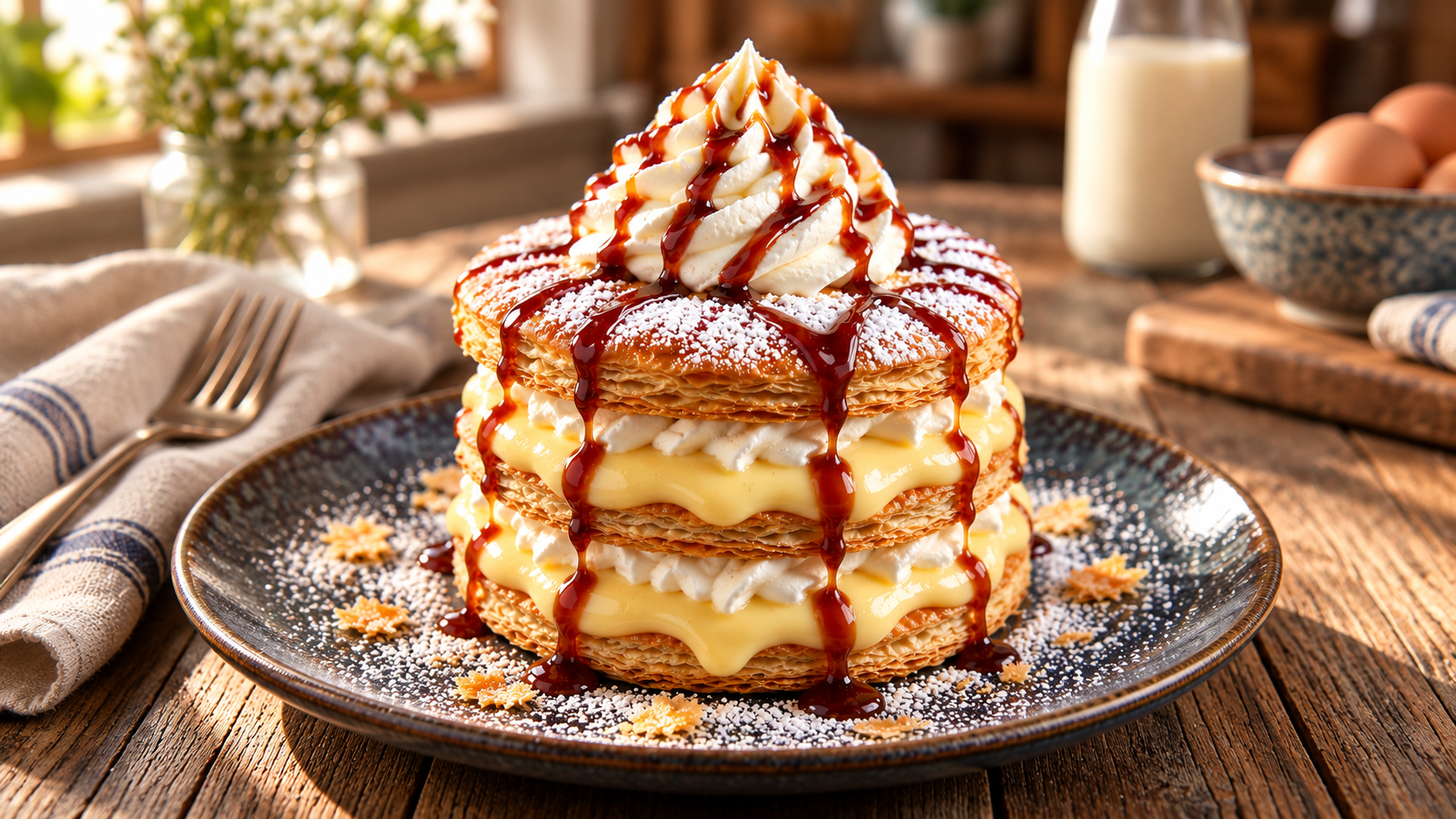
Vanilla Custard Napoleon brings together everything we love about an old-fashioned bakery dessert: delicate golden pastry, thick homemade vanilla custard, billowy whipped cream, and rich caramel flowing gently over the top.
Imagine placing your fork against a beautifully browned puff pastry crust. The first gentle press creates a satisfying crunch. Then, just beneath those crisp buttery flakes, you discover a generous layer of cool, silky vanilla custard and soft whipped cream.
One bite delivers the perfect combination of textures. The pastry shatters delicately, the custard melts smoothly across your tongue, and the caramel adds a sweet, buttery finish.
This homemade dessert looks elegant enough for a special celebration. Yet it uses familiar ingredients and straightforward techniques that home bakers can master.
Our version features three individual puff pastry rounds per serving, separated by two generous fillings of real vanilla custard and whipped cream. A tall swirl of whipped cream, powdered sugar, and glossy caramel sauce complete the presentation.
Whether you’re preparing dessert for a Sunday family gathering, holiday dinner, birthday celebration, or simply a cozy afternoon treat, this Vanilla Custard Napoleon recipe delivers a wonderful bakery-style experience.
Table of Contents
What Is Vanilla Custard Napoleon?
A Vanilla Custard Napoleon is a layered pastry dessert inspired by the traditional French mille-feuille.
The French name mille-feuille means “a thousand leaves,” referring to the many delicate sheets created when laminated puff pastry bakes.
Despite the name, the dessert does not literally require one thousand separate pieces of pastry.
Instead, thin layers of butter and dough expand in the oven, forming a crisp, light structure with a beautiful golden color.
A classic Napoleon commonly combines three puff pastry sheets with two layers of pastry cream. Some traditional versions feature a sugar-glazed top decorated with chocolate.
Our Vanilla Custard Napoleon follows that same basic layered structure while embracing the rich, generous presentation loved in American home baking.
Each serving contains three circular pastry rounds, two custard-and-whipped-cream fillings, and a decorative whipped cream topping.
Finally, powdered sugar and caramel give the dessert its warm bakery-style finish.
A French Classic with an American Bakery Twist
French pastry traditions often favor precise layers and carefully controlled portions.
American bakery desserts, meanwhile, frequently celebrate generous cream fillings, familiar vanilla flavors, and sweet sauces.
This recipe brings those styles together.
The puff pastry remains delicate and golden. The vanilla custard provides a classic pastry-shop flavor. Meanwhile, the whipped cream makes the filling feel lighter, softer, and wonderfully indulgent.
Caramel adds another layer of flavor without changing the identity of the dessert.
The result is a Napoleon-inspired pastry that feels special but still belongs at a welcoming family table.
Why You’ll Love This Homemade Dessert
There are plenty of beautiful pastries in the world. However, few combine crispy edges and creamy centers as successfully as a well-made Napoleon.
Here’s why this particular dessert deserves a place in your recipe collection.
1. Beautiful Contrast in Every Bite
The most memorable feature is the contrast between flaky pastry and soft custard.
The crisp layers create a gentle crunch, while the vanilla cream provides a cool, smooth finish.
Rather than competing, these textures complement one another.
2. Real Homemade Vanilla Custard
This recipe uses egg yolks, whole milk, sugar, and cornstarch to create a genuine cooked custard.
It is not simply instant pudding folded into whipped cream.
The cooked mixture develops a rich, silky texture that holds beautifully between the pastry rounds.
3. Three Beautiful Golden Pastry Layers
Each individual dessert has three separate puff pastry rounds.
These are the base, middle, and upper pastry components.
The two spaces between them are filled generously with custard and whipped cream, creating a tall, attractive dessert without inventing extra pastry layers.
4. A Rich Caramel Finish
Caramel sauce adds a buttery sweetness that works beautifully with vanilla custard.
A controlled drizzle creates an appealing glossy finish without overwhelming the pastry.
5. Perfect for Family Celebrations
Individual Napoleons make lovely plated desserts for birthdays, holidays, family dinners, and special occasions.
They look impressive without requiring complicated cake decorating.
6. Convenient Preparation
You can prepare the custard and pastry components in advance.
Then, assemble the desserts shortly before serving to preserve their wonderful texture.
7. Familiar Ingredients
Most ingredients are commonly available in American grocery stores.
Using ready-made all-butter puff pastry also makes the preparation much more manageable.
What Makes This Vanilla Custard Napoleon Different?
The visual identity of this dessert comes from its distinct components.
It is important to understand what each one contributes before beginning.
| Component | Texture | Purpose |
|---|---|---|
| Golden puff pastry | Crisp, flaky, buttery | Provides structure and crunch |
| Homemade vanilla custard | Thick, smooth, silky | Creates the rich creamy filling |
| Whipped cream | Soft, airy, fluffy | Adds lightness and generous volume |
| Caramel sauce | Glossy, thick, buttery | Adds sweetness and an attractive finish |
| Powdered sugar | Fine, delicate | Provides the classic bakery appearance |
Unlike a soft layered sponge cake, a Napoleon should retain some crispness in its pastry.
Unlike a cheesecake, its filling is based on cooked custard rather than cream cheese.
And unlike a pudding cake, its pastry and filling are prepared separately before assembly.
Understanding these distinctions helps keep the recipe authentic and visually accurate.
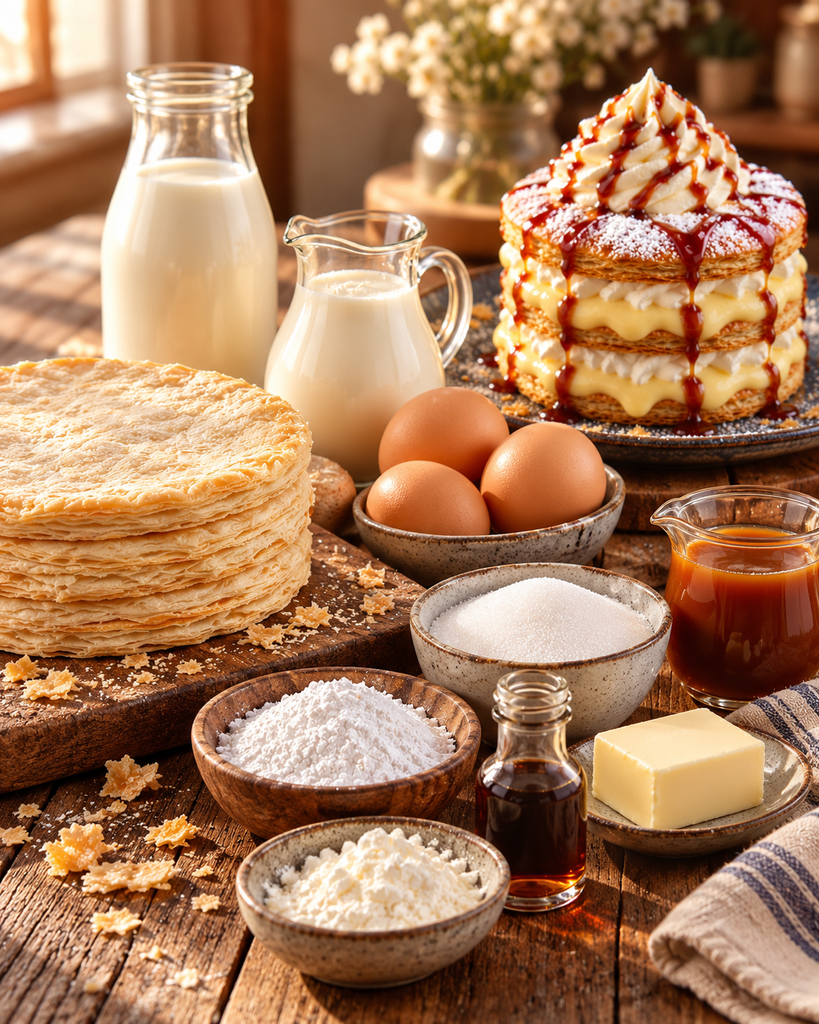
Ingredients for Vanilla Custard Napoleon
This recipe makes four individual Napoleons, each using three pastry rounds.
For the Golden Puff Pastry
- 2 sheets all-butter puff pastry, thawed but still cold (approximately 17 ounces total)
- 2 tablespoons powdered sugar, for finishing
Choose a puff pastry that contains real butter when possible.
Butter contributes flavor and supports the delicate layered structure that makes this dessert special.
Keep the dough cold until you’re ready to cut it.
For the Homemade Vanilla Custard
- 2 cups whole milk
- 4 large egg yolks
- ½ cup granulated sugar
- ¼ cup cornstarch
- 2 tablespoons unsalted butter
- 2 teaspoons pure vanilla extract
- ¼ teaspoon fine salt
Whole milk creates a full, creamy taste.
Egg yolks provide richness, while cornstarch thickens the custard enough to hold between the pastry layers.
Butter adds a smooth finish, and vanilla provides the familiar homemade bakery flavor.
For the Fluffy Whipped Cream
- 1½ cups cold heavy whipping cream
- ¼ cup powdered sugar
- 1 teaspoon pure vanilla extract
Heavy cream works best because it can be whipped into stable peaks.
Powdered sugar dissolves easily, leaving the cream smooth rather than grainy.
For the Caramel Topping
- ½ cup thick caramel dessert sauce, cooled
- Additional powdered sugar, as needed
Use a spoonable caramel sauce that is thick enough to coat the back of a spoon.
Avoid hot caramel, which can soften or melt the whipped cream.
Choosing the Best Ingredients
Puff pastry: Look for frozen sheets rather than pre-baked shells. Sheets allow you to create evenly sized circular layers.
Milk: Whole milk provides a richer custard than skim milk.
Eggs: Large eggs are appropriate for the proportions used here.
Vanilla: Pure vanilla extract gives a rounded flavor. Vanilla bean paste is another excellent option.
Cream: Use heavy whipping cream with sufficient milk fat to produce firm peaks.
Caramel: Choose a thick dessert sauce rather than a watery syrup.
The ingredients are simple, but selecting them carefully improves both flavor and appearance.
Essential Equipment
You do not need professional pastry equipment to prepare this dessert.
However, several ordinary kitchen tools make the process easier.
- Two baking sheets
- Parchment paper
- A 4-inch round pastry cutter
- Medium saucepan
- Whisk
- Heatproof mixing bowls
- Fine-mesh sieve
- Electric hand mixer
- Wire cooling rack
- Piping bag with a large star tip
- Offset spatula
- Serving plates
A pastry cutter helps produce uniform rounds. Meanwhile, a piping bag gives the whipped cream its distinctive soft swirls.
If you do not own a piping bag, a sturdy food-safe bag fitted with a piping tip can work.
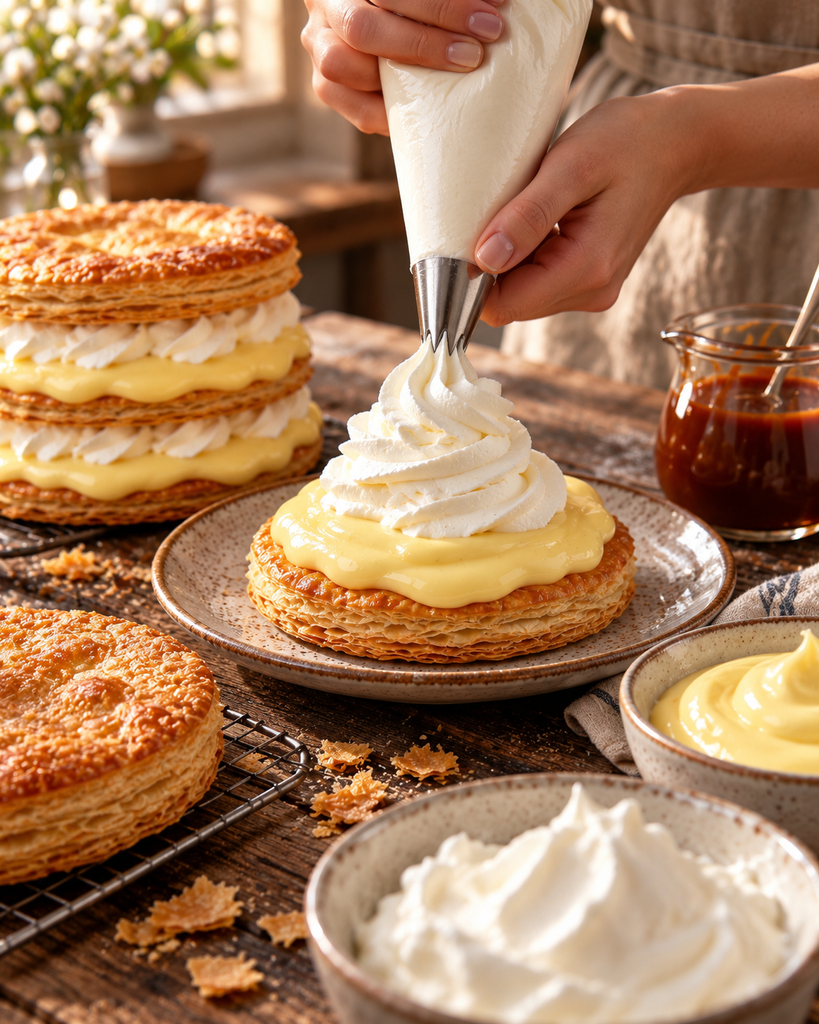
How to Make Vanilla Custard Napoleon Step by Step
For the best workflow, prepare the custard first so it can chill while you bake the pastry.
Then whip the cream and assemble the dessert only when all components are completely cool.
Step 1: Prepare the Vanilla Custard Base
Pour the whole milk into a medium saucepan.
Set it over medium heat and warm until steaming. Do not allow it to boil vigorously.
Meanwhile, place the egg yolks, granulated sugar, cornstarch, and salt in a separate bowl.
Whisk thoroughly until the mixture becomes smooth and slightly lighter in color.
The cornstarch should be completely incorporated before adding the milk.
Next, gradually pour approximately half the warm milk into the egg mixture while whisking continuously.
This process, called tempering, gently raises the temperature of the eggs and helps prevent scrambling.
Pour the tempered mixture back into the saucepan with the remaining milk.
Step 2: Cook Until Thick and Silky
Return the saucepan to medium heat.
Whisk continuously, paying special attention to the bottom and corners of the pan.
At first, the liquid will appear thin. As it heats, the starch begins to thicken the mixture.
Continue until the custard becomes thick and begins bubbling.
Cook for approximately one additional minute while whisking.
Then remove the saucepan from the heat.
Stir in the butter and vanilla extract until completely incorporated.
The finished custard should look smooth, glossy, and rich.
It should be thick enough to mound softly on a spoon.
Step 3: Chill the Custard Properly
Transfer the hot custard to a shallow heatproof bowl or container.
Press food-safe plastic wrap directly against the surface to prevent a skin from forming.
Cool promptly and refrigerate until thoroughly chilled, approximately two hours.
Do not leave the custard sitting on the counter for an extended period.
Cold custard is essential for assembly because warm filling will soften the pastry and collapse the whipped cream.
Once chilled, whisk briefly until smooth before transferring it to a piping bag.
If the custard appears slightly firm, gentle whisking will restore a creamy consistency.
Step 4: Cut the Puff Pastry Rounds
Preheat the oven to 400°F (200°C).
Line two baking sheets with parchment paper.
Unfold the thawed puff pastry on a lightly floured work surface.
Using a 4-inch round cutter, cut twelve pastry circles.
Arrange them on the prepared baking sheets, leaving space between the rounds.
If necessary, gently reroll the scraps once to obtain the required twelve circles. Depending on the dimensions of your pastry sheets, a small amount of trimming may be needed.
Avoid stretching or repeatedly rerolling the dough.
Excessive handling can compress the buttery layers and reduce flakiness.
Prick the pastry lightly with a fork.
This helps limit excessive puffing and encourages a more manageable shape for stacking.
Step 5: Bake Until Golden and Crisp
Cover the pastry circles with another sheet of parchment.
Place an additional baking sheet over the pastry to weigh it down gently.
Bake for approximately 15 minutes.
Carefully remove the upper baking sheet and parchment.
Continue baking for another 7–10 minutes, or until the pastry is deeply golden and crisp.
The exact baking time may vary with the thickness of the dough and your oven.
Look for dry, golden surfaces rather than pale or doughy centers.
Transfer the pastry rounds to a wire rack.
Allow them to cool completely before adding any filling.
For the best Napoleon texture, the pastry should be dry, delicate, and flaky.
Step 6: Whip the Cream
Place the cold heavy whipping cream in a chilled mixing bowl.
Add the powdered sugar and vanilla extract.
Beat on medium speed until the mixture begins to thicken.
Increase the speed gradually and continue until firm peaks form.
Stop as soon as the whipped cream holds its shape.
Overwhipping may produce a grainy texture.
The finished cream should be smooth, fluffy, and firm enough to pipe decorative swirls.
Refrigerate until assembly.
Step 7: Assemble the Three Golden Layers
Place one completely cooled puff pastry round in the center of a serving plate.
Pipe approximately one-eighth of the chilled custard over the round, leaving a small border around the edge.
Add approximately one-tenth of the whipped cream, piping soft swirls over the custard.
Carefully place a second pastry round on top.
Repeat with another portion of custard and whipped cream.
Finally, position the third pastry round on top.
Pipe a tall decorative swirl of whipped cream in the center, using the remaining cream across the four servings.
Repeat the process for the other three desserts.
Each Napoleon should have:
- Three golden puff pastry rounds
- Two thick custard fillings
- Two interior whipped cream layers
- One decorative whipped cream topping
Do not add extra pastry rounds or unrelated fillings.
A gentle touch is important during assembly. Pressing too firmly may crack the pastry or force the filling out of the sides.
Step 8: Finish with Caramel and Powdered Sugar
Dust the upper pastry layer lightly with powdered sugar.
Next, drizzle a modest amount of cooled caramel sauce over the whipped cream and pastry.
Allow a few narrow ribbons of caramel to travel naturally down the sides.
The goal is a rich, glossy appearance rather than a puddle of sauce.
Keep some of the golden pastry visible so the crisp texture remains part of the presentation.
Serve immediately, or refrigerate briefly if needed.
For the strongest contrast between crispy pastry and silky filling, assemble as close to serving time as possible.
7 Irresistible Tips for Perfect Vanilla Custard Napoleon Layers
Making a beautiful Napoleon is largely about temperature, texture, and timing.
These seven practical tips help produce consistent results.
Tip 1: Keep the Puff Pastry Cold
Puff pastry depends on distinct layers of dough and butter.
If the pastry becomes too warm before baking, the butter can soften excessively.
This makes the dough harder to handle and may reduce its delicate rise.
Work quickly, and return the cut pastry to the refrigerator briefly if it becomes soft.
Cold pastry is easier to shape and generally produces a cleaner result.
Tip 2: Bake the Pastry Completely
Pale puff pastry may look finished but still contain moisture.
That moisture becomes especially noticeable once the custard is added.
Bake until the rounds develop a deep golden color and feel dry and crisp.
Allow them to cool on a rack so steam can escape.
Tip 3: Make the Custard Thick Enough to Hold
A loose custard will spread beyond the edges of the pastry.
Therefore, cook the mixture until clearly thickened and bubbling.
Do not stop simply because it begins coating the whisk.
The custard should have enough body to hold a generous layer after chilling.
Tip 4: Cool Every Component Before Assembly
This may be the most important rule.
Warm custard can melt whipped cream.
Warm pastry can create condensation.
Even slightly warm caramel may damage decorative cream swirls.
Ensure the custard, pastry, and caramel are all properly cooled before building the dessert.
Tip 5: Create Generous but Balanced Fillings
The reference dessert looks luxurious because the cream fillings are thick and clearly visible.
However, piling on too much custard may make the structure unstable.
Divide the filling evenly and keep the pastry rounds centered.
You want generous cream without a collapsing tower.
Tip 6: Use Controlled Caramel Drizzles
A few glossy ribbons look more attractive than excessive sauce.
Start with a small amount.
Add more only where needed to emphasize the whipped cream and pastry edges.
A thick caramel creates attractive lines while staying on the dessert.
Tip 7: Assemble Shortly Before Serving
This final tip makes a noticeable difference.
Freshly assembled Napoleon offers the most dramatic contrast between crisp pastry and smooth filling.
After several hours in the refrigerator, the pastry naturally absorbs moisture.
Some people enjoy the softer texture. However, if your goal is an audible crunch, fresh assembly is the better choice.
Understanding the Perfect Pastry and Custard Texture
A memorable Vanilla Custard Napoleon depends on more than sweetness.
Its appeal comes from how the ingredients behave together.
Why Puff Pastry Becomes Flaky
Puff pastry is made from alternating layers of dough and butter.
During baking, heat creates steam while the butter contributes to separation between the dough sheets.
The result is a delicate structure made of many crisp, thin layers.
This texture is different from shortcrust pastry, sponge cake, or ordinary cookies.
For readers interested in making puff pastry from scratch, King Arthur Baking’s classic puff pastry guide explains the traditional laminated dough method.
Ready-made all-butter puff pastry is a convenient alternative when you want excellent results without preparing the dough over several hours.
Why Custard Needs Egg Yolks and Cornstarch
Egg yolks add richness, color, and flavor.
Cornstarch thickens the milk-based mixture as it heats.
Together, these ingredients produce a smooth, spoonable filling suitable for a layered dessert.
Butter contributes additional richness, while vanilla completes the flavor.
Unlike an instant pudding mixture, this custard is cooked directly on the stovetop.
That traditional preparation gives you greater control over its final thickness.
Why Whipped Cream Makes a Difference
Using only dense custard could make a tall Napoleon feel heavy.
Whipped cream introduces airiness.
It softens the richness and adds attractive white layers between the pale-yellow custard and golden pastry.
The combination creates a particularly appealing contrast in both flavor and appearance.
Why the Caramel Must Be Thick
Thin caramel syrup tends to run quickly.
It may soak into the pastry or collect on the plate.
A thicker sauce stays more controlled, creating beautiful glossy ribbons.
It also adds sweetness without turning the dessert into a soggy pastry.
Common Vanilla Custard Napoleon Mistakes and How to Fix Them
Even experienced bakers occasionally encounter challenges with layered pastries.
Fortunately, most are easy to prevent.
| Problem | Likely Cause | Best Solution |
|---|---|---|
| Pastry becomes soggy | Assembled too early | Fill shortly before serving |
| Custard runs out | Insufficient cooking or chilling | Cook until thick and chill completely |
| Pastry rounds shrink | Dough stretched during cutting | Cut gently and keep cold |
| Whipped cream collapses | Cream too warm or underwhipped | Use cold cream and beat to firm peaks |
| Filling looks lumpy | Uneven mixing or overheating | Whisk thoroughly; strain if needed |
| Caramel slides off | Sauce too thin or warm | Use thick, cooled caramel |
| Napoleon leans sideways | Uneven filling or off-center layers | Distribute fillings evenly |
What If the Custard Is Too Thick?
Chilled custard naturally becomes firmer.
Before assembly, whisk it briefly.
If it remains unusually stiff, whisk in a very small amount of cold milk until it becomes smooth and pipeable.
Do not add too much liquid at once.
What If the Custard Is Too Thin?
Thin custard may indicate that it did not cook long enough.
If the mixture is still warm, return it to gentle heat and whisk until thickened.
If it has already chilled and remains runny, it is better to correct the custard before assembly rather than attempt to hide the problem with extra whipped cream.
What If the Puff Pastry Rises Unevenly?
Puff pastry can develop irregular bubbles.
Lightly pricking the rounds and baking them beneath a second tray helps control excessive expansion.
Small irregularities are normal and can add a charming handmade appearance.
What If the Top Pastry Cracks?
A few flakes or cracks are expected.
In fact, that delicate structure is part of the appeal.
However, avoid pushing directly down on the center while stacking.
Support the pastry gently around its edges when positioning each round.
Delicious Vanilla Custard Napoleon Variations
Once you master the original recipe, small flavor changes can create wonderful seasonal desserts.
Keep the basic three-round structure intact when adapting the recipe.
Strawberry Vanilla Napoleon
Add a thin layer of well-drained sliced strawberries between the custard and whipped cream.
Use ripe berries and avoid adding excess juice.
This version is especially appealing during spring and early summer.
The fruit introduces a fresh, slightly tart contrast to the rich vanilla filling.
Chocolate Custard Napoleon
Replace a portion of the vanilla custard with a properly prepared chocolate pastry cream.
A dark chocolate finish works beautifully with the golden pastry.
For an attractive presentation, keep the pastry rounds visible rather than covering the entire dessert.
Salted Caramel Napoleon
Use salted caramel sauce for the topping.
Its gentle saltiness helps balance the sweetness of the custard and whipped cream.
This is a lovely variation for fall gatherings.
Lemon Vanilla Napoleon
Add a modest amount of finely grated lemon zest to the cooked custard.
The citrus aroma creates a brighter, lighter flavor.
Avoid adding excessive lemon juice, which may change the filling consistency.
For another custard-centered dessert, explore our Magic Lemon Custard Cobbler.
Holiday Cinnamon Napoleon
Add a small pinch of cinnamon to the custard or caramel.
The warm spice gives the dessert a cozy seasonal character without overpowering the vanilla.
This variation works especially well for Thanksgiving and Christmas gatherings.
Coconut Cream Napoleon
Add a little coconut extract to the custard and finish with lightly toasted coconut.
Keep the coconut garnish restrained so it does not hide the flaky pastry.
For a richer coconut flavor, part of the dairy can be replaced with an appropriate coconut milk product, although the custard thickness may need adjustment.
Make-Ahead, Storage, and Serving Tips
One of the smartest ways to prepare Vanilla Custard Napoleon is to separate the work into stages.
This reduces stress and helps preserve the final texture.
Can You Make Vanilla Custard Napoleon Ahead?
Yes, but the individual components should be stored separately.
Prepare the custard one day ahead and refrigerate it in a covered container.
Bake the pastry rounds ahead of time, cool completely, and store them in a dry airtight container once fully cooled.
Whipped cream is best prepared on the day of serving for maximum volume and freshness.
Assemble the pastries shortly before dessert time.
How Long Does the Assembled Dessert Last?
For the best texture, enjoy the dessert soon after assembly.
If necessary, store assembled Napoleons covered in the refrigerator and consume within two days.
The pastry will gradually soften as it absorbs moisture from the custard.
Although the flavor remains appealing, the crisp texture will not be identical to a freshly assembled Napoleon.
Can You Freeze It?
Freezing the completed dessert is not recommended.
Thawing may affect the whipped cream, alter the custard texture, and leave the pastry damp.
Instead, freeze unused raw puff pastry according to its package instructions.
Freshly cooked custard and whipped cream are best kept refrigerated rather than frozen for this particular presentation.
Important Food Safety Advice
Because the filling contains eggs and dairy, refrigeration is essential.
Store the finished dessert at 40°F (4°C) or below.
Do not leave it at room temperature for more than two hours, or more than one hour in temperatures above 90°F (32°C).
For further guidance, consult FoodSafety.gov’s food safety recommendations.
How to Serve a Beautiful Napoleon
Choose a plate large enough to hold the dessert without crowding it.
Position the pastry stack near the center.
Pipe the final whipped cream swirl carefully, allowing it to remain tall and well-defined.
Dust lightly with powdered sugar.
Then drizzle caramel across the cream and upper pastry.
Serve with a dessert fork so guests can enjoy the delicate, crispy layers.
For a dramatic presentation, place the dessert on the table just before serving.
The contrast between golden pastry, pale custard, white cream, and dark caramel creates a particularly inviting appearance.
What to Serve with Vanilla Custard NapoleonBecause this dessert is rich and creamy, simple accompaniments work best.
Freshly Brewed Coffee
Coffee balances the sweetness of caramel and vanilla.
Its slightly bitter notes complement the pastry’s buttery flavor.
A small cup of freshly brewed coffee is an excellent pairing after a family dinner.
Hot Tea
Black tea, Earl Grey, or a gentle herbal tea also pairs beautifully with this dessert.
Choose a tea that will not overwhelm the vanilla custard.
Fresh Berries
A small serving of strawberries or raspberries provides a fresh contrast.
Place the berries beside the dessert rather than directly on the pastry if you want to preserve the original presentation.
A Light Dessert Selection
When hosting a celebration, you can offer smaller Napoleon portions alongside another cream-based dessert.
For example, readers who enjoy traditional pastry fillings may also love our Karpatka Polish Cream Cake.
If you’re planning a larger dessert buffet, consider our Tiramisu Casserole as another creamy option.
Both provide different textures and flavors while fitting naturally into a homemade dessert spread.
Frequently Asked Questions About Vanilla Custard Napoleon
What is Vanilla Custard Napoleon made of?
Vanilla Custard Napoleon is made with baked puff pastry, cooked vanilla custard, and whipped cream.
This version also features powdered sugar and a thick caramel topping.
Each individual dessert contains three pastry rounds with two cream-filled spaces between them.
Is Napoleon the same as mille-feuille?
The names are often used for closely related layered puff pastry desserts.
Traditional preparations may differ in filling, shape, and decoration.
Mille-feuille commonly refers to the French pastry made with crisp puff pastry and pastry cream.
Our recipe is a round, caramel-finished variation inspired by that tradition.
Can I use store-bought puff pastry?
Absolutely.
Ready-made all-butter puff pastry is a practical choice for home bakers.
It saves preparation time while still producing the delicate golden layers essential to this dessert.
Can I use instant pudding instead of homemade custard?
Instant pudding would produce a different dessert.
For this recipe, real cooked vanilla custard is recommended because its flavor and structure are central to the finished Napoleon.
The homemade custard is rich, thick, and suitable for piping between pastry rounds.
Why is my Napoleon pastry soggy?
Moisture gradually moves from the custard into the pastry.
This naturally softens the crisp layers over time.
To reduce sogginess, cool the pastry completely, use sufficiently thick custard, and assemble shortly before serving.
How do I make the custard extra creamy?
Use whole milk, fresh egg yolks, and butter.
Whisk continuously during cooking.
Then cool the custard properly and whisk briefly before piping.
Avoid adding too much milk after chilling, which may weaken its structure.
Can I make Vanilla Custard Napoleon without whipped cream?
Yes, you can prepare a more traditional version using pastry cream alone.
However, the result will not match the specific airy white cream layers and tall whipped topping shown in this AstroRecipes presentation.
What is the best caramel sauce for Napoleon?
Choose a thick, smooth caramel dessert sauce that flows slowly from a spoon.
It should be completely cooled before adding it to the whipped cream.
A homemade butter-and-cream caramel or suitable prepared dessert sauce will work.
How many pastry layers are in this recipe?
There are exactly three separate golden puff pastry rounds per Napoleon.
Each round also contains many thin, flaky sheets formed during baking.
The assembled dessert has two custard-and-whipped-cream fillings between the three pastry rounds.
Can I make mini Napoleons for a party?
Yes.
Use smaller round pastry cutters and adjust the custard and whipped cream portions accordingly.
Smaller Napoleons are wonderful for buffets, bridal showers, and holiday dessert tables.
The yield will depend on the diameter of the pastry rounds.
Should Vanilla Custard Napoleon be served cold?
The custard and whipped cream should remain chilled.
The finished dessert is best served cool, with crisp pastry and thick cream.
Avoid serving it warm because heat may soften or melt the fillings.
What is the difference between pastry cream and whipped cream?
Pastry cream is a cooked custard, usually made from milk, egg yolks, sugar, and a thickener.
Whipped cream is cold heavy cream beaten to incorporate air.
Pastry cream provides richness and structure, while whipped cream adds lightness and volume.
This dessert uses both for a fuller bakery-style experience.
Final Thoughts: A Little Bakery Magic at Home
There is something unforgettable about a dessert that combines crisp pastry with thick, silky cream.
This Vanilla Custard Napoleon captures that contrast in a beautiful individual serving.
Three golden puff pastry rounds create the structure. Homemade vanilla custard delivers a rich, traditional filling. Fluffy whipped cream adds softness, while caramel brings everything together with a glossy finish.
The result feels elegant enough for a bakery display but welcoming enough for a family kitchen.
Most importantly, every component has a purpose. Nothing needs to be excessive or complicated.
Take your time preparing the custard, bake the pastry until beautifully crisp, and assemble with a gentle hand.
Then bring the dessert to the table, pick up a fork, and enjoy that delightful moment when the golden pastry gives way to cool vanilla cream.
From our AstroRecipes kitchen to yours, may every bite bring a little sweetness, comfort, and homemade joy.
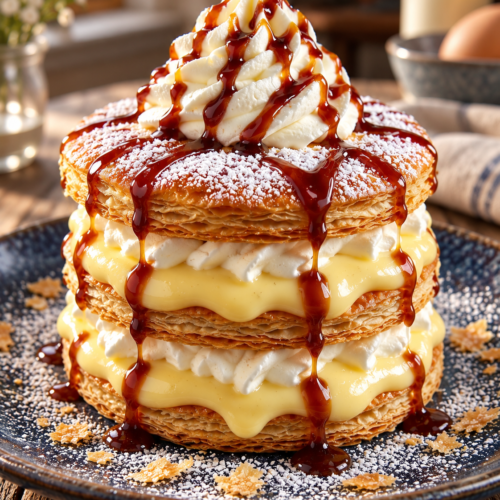
Vanilla Custard Napoleon with Caramel Cream

Equipment
- two baking sheets For baking the pastry rounds and gently weighing them down.
- Parchment Paper For lining the baking sheets and covering the pastry.
- 4-inch round pastry cutter For cutting twelve uniform pastry circles.
- Medium saucepan For heating the milk and cooking the vanilla custard.
- Whisk For tempering the egg yolks and preparing a smooth custard.
- heatproof mixing bowls For mixing, tempering, and chilling the custard.
- fine-mesh sieve For straining the custard if needed.
- electric hand mixer For whipping the heavy cream until firm peaks form.
- wire cooling rack For cooling the baked pastry rounds completely.
- piping bag with large star tip For piping custard, whipped cream layers, and decorative swirls.
- offset spatula For spreading and adjusting the cream fillings.
- serving plates For assembling and presenting the individual Napoleons.
Ingredients
- 2 sheets all-butter puff pastry, thawed but still cold (approximately 17 oz total)
- 2 tbsp powdered sugar, for finishing the puff pastry
- 2 cups whole milk
- 4 large egg yolks
- ½ cup granulated sugar
- ¼ cup cornstarch
- 2 tbsp unsalted butter
- 2 tsp pure vanilla extract, for the custard
- ¼ tsp fine salt
- 1 ½ cups cold heavy whipping cream
- ¼ cup powdered sugar, for the whipped cream
- 1 tsp pure vanilla extract, for the whipped cream
- ½ cup thick caramel dessert sauce, cooled
- additional powdered sugar, as needed for topping
Instructions
- Pour the whole milk into a medium saucepan and warm over medium heat until steaming, without allowing it to boil vigorously. In a separate heatproof bowl, whisk together the egg yolks, granulated sugar, cornstarch, and salt until smooth and slightly lighter in color. Gradually pour approximately half of the warm milk into the egg mixture while whisking continuously to temper the yolks. Pour the tempered mixture back into the saucepan with the remaining milk.
- Return the saucepan to medium heat and whisk continuously, making sure to reach the bottom and corners of the pan. Continue cooking until the custard thickens and begins bubbling. Cook for approximately one additional minute while whisking. Remove from the heat and stir in the unsalted butter and vanilla extract until completely incorporated. The finished custard should be thick, smooth, and glossy, holding a soft mound on a spoon.
- Transfer the hot custard to a shallow heatproof container. Press food-safe plastic wrap directly against the surface to prevent a skin from forming. Cool promptly and refrigerate until thoroughly chilled, approximately 2 hours. Once cold, whisk briefly to restore a smooth, creamy consistency before transferring the custard to a piping bag. If necessary, add a very small amount of cold milk to loosen an overly firm custard.
- Preheat the oven to 400°F (200°C) and line two baking sheets with parchment paper. Unfold the cold, thawed puff pastry on a lightly floured work surface. Using a 4-inch round pastry cutter, cut twelve circles. If necessary, gently reroll the scraps once to obtain all twelve rounds. Arrange the circles on the prepared baking sheets, leaving space between them. Prick each round lightly with a fork to help control excessive puffing. Avoid stretching or overworking the dough.
- Cover the pastry rounds with another sheet of parchment paper and place an additional baking sheet on top to weigh them down gently. Bake for approximately 15 minutes. Carefully remove the upper baking sheet and parchment, then continue baking for another 7–10 minutes, until the pastry is deeply golden, dry, and crisp. Transfer the baked rounds to a wire cooling rack and allow them to cool completely before assembly.
- Place the cold heavy whipping cream in a chilled mixing bowl. Add the powdered sugar and vanilla extract. Beat with an electric hand mixer on medium speed until the cream begins to thicken, then gradually increase the speed. Continue beating until firm peaks form and the whipped cream holds its shape. Avoid overwhipping, which can produce a grainy texture. Refrigerate the whipped cream until ready to assemble.
- Place one completely cooled puff pastry round in the center of a serving plate. Pipe approximately one-eighth of the chilled vanilla custard onto the pastry, leaving a small border. Add approximately one-tenth of the whipped cream in soft swirls over the custard. Carefully position a second pastry round on top and repeat with another portion of custard and whipped cream. Finish with a third golden pastry round. Pipe a tall decorative whipped cream swirl on top, distributing the remaining cream among the four desserts. Repeat for the other three Napoleons. Each finished dessert should contain exactly three pastry rounds and two interior layers of custard and whipped cream.
- Lightly dust the top pastry layer with powdered sugar. Drizzle a modest amount of completely cooled, thick caramel dessert sauce over the whipped cream and pastry, allowing a few narrow ribbons to run naturally down the sides. Keep some of the golden pastry visible for an attractive bakery-style presentation. Serve immediately for the best contrast between crisp pastry and creamy filling, or refrigerate briefly until serving.
Notes
Nutrition
More Southern recipes worth savoring — timeless classics, grandmother’s kitchen secrets, and Claire Malin’s own take on the flavors that have always called the South home:
astrarecipes.com/category/southern-bites/
and on our Facebook page:
https://www.facebook.com/astrorecipes1
Recipes I Think You’ll Love