

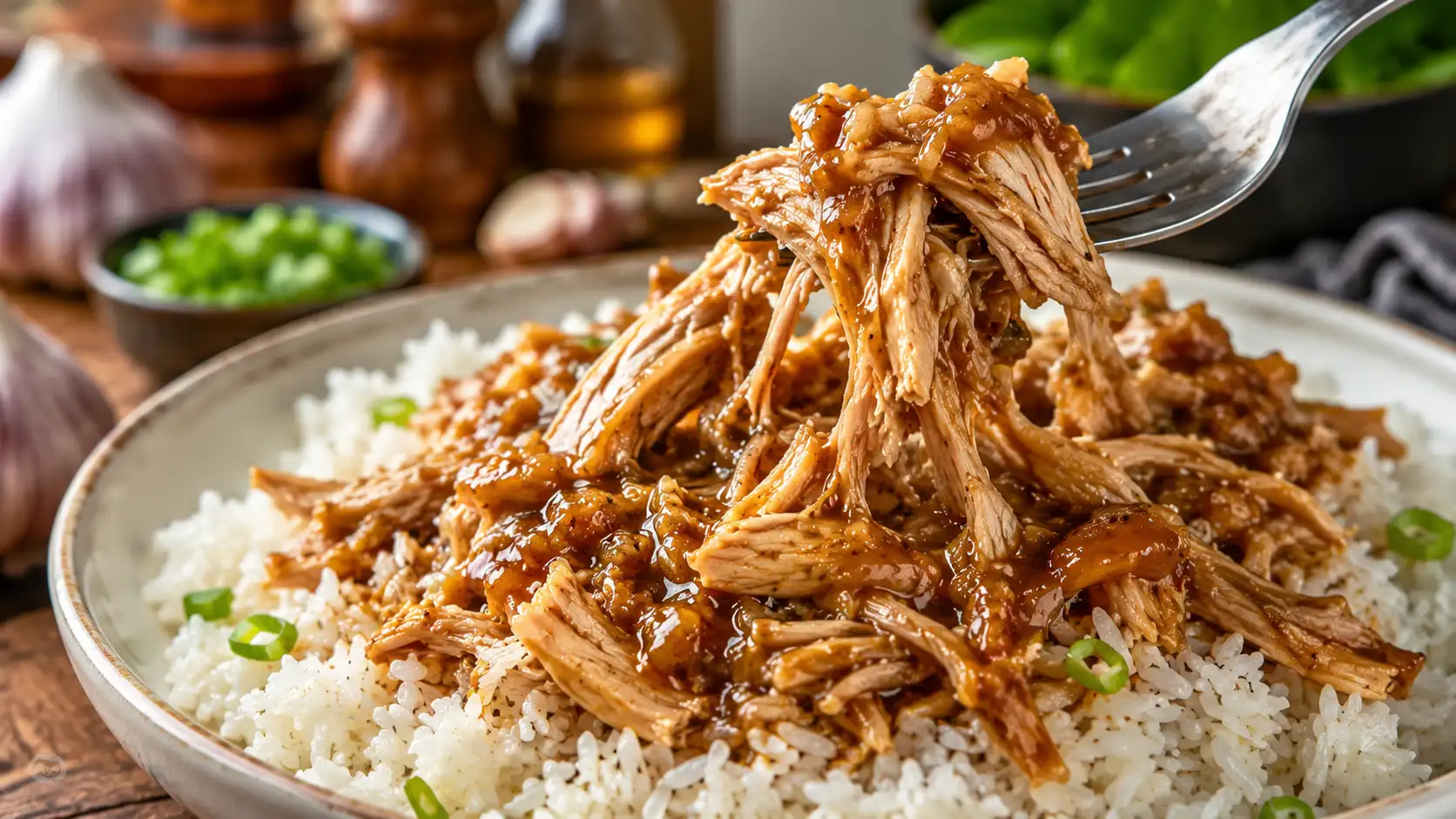
Sweet, Glossy, Shredded Chicken • One Skillet • 30 Minutes • Sauce That Clings to Everything
Claire Malin has cooked a great many weeknight dinners in her years writing for AstroRecipes’ Southern Bites — slow braises, skillet fish, baked cobblers that take most of an afternoon. But when someone asks her what recipe she reaches for when it is Tuesday, the fridge is not full, and dinner needs to be on the table in thirty minutes without sacrificing a single thing in the way of flavour — the answer is always this. Sticky garlic chicken over rice. And yes, it is exactly as dangerous as the name suggests.
Dangerous because of the sauce. A sauce built from garlic, soy, honey, maple syrup, and a hit of ketchup or chili sauce that thickens in the pan until it is glossy, sticky, and clings to every shredded piece of chicken like it was designed specifically for that purpose — because it was. Dangerous because once you have made it once, you will find yourself thinking about it on the drive home from work. Dangerous because the leftovers, if there are any, are arguably better the next day.
This sticky garlic chicken over rice is a 30-minute dinner that tastes like it took considerably longer. One skillet, a handful of pantry staples, and a technique so simple that the hardest part is waiting for the sauce to thicken before you start eating it with a spoon. The South would drown the rice in extra sauce. The North might keep it neater. The correct answer, as always in Southern Bites, is more sauce.
Table of Contents
Why Sticky Garlic Chicken Over Rice Wins Every Weeknight
- Thirty minutes from cold pan to plated dinner — genuinely, not optimistically. Ten minutes of prep, twenty minutes of cooking, done.
- The sauce is built entirely from pantry staples: soy sauce, honey, maple syrup, garlic, and one tablespoon of ketchup or chili sauce that adds body and a subtle depth nobody can identify but everybody notices.
- Shredding the chicken into the sauce is the move that transforms this from a simple pan dish into something that looks and tastes like a restaurant delivery order — every strand of chicken fully coated, every bite glossy and flavourful.
- It works with chicken breasts or thighs — thighs produce a richer, more forgiving result; breasts are leaner and shred into longer, cleaner strands. Both are correct.
- The leftovers are exceptional. The sauce penetrates the shredded chicken overnight and the next day’s bowl is even better than the first.
- It is naturally dairy-free and easily gluten-free with a tamari substitution. One recipe, multiple dietary requirements satisfied without any additional effort.
Understanding the Sticky Garlic Sauce
The sauce is the reason this dish exists and the reason it gets requested again. It is worth understanding each component — not because the recipe is complicated, but because knowing why each ingredient is there makes you a better cook of it and of everything like it.
Garlic
Four cloves, minced finely. Garlic is the flavour backbone of the sauce — it blooms in the butter and olive oil before the liquids go in, and then simmers through the entire cooking time, mellowing from sharp and pungent to sweet and deep. Do not use pre-minced garlic from a jar here. Fresh garlic is the foundation and the jar version produces a flat, slightly acrid result that undermines everything built around it.
Soy Sauce
The salt and the umami of the sauce. A quarter cup provides the deep, savoury backbone that makes the sweet elements taste rounded rather than cloying. Use a standard soy sauce — dark soy produces a richer colour and slightly deeper flavour; light soy is more delicate. Either works. For a gluten-free version, swap for tamari in equal quantities — the result is nearly identical.
Honey and Maple Syrup
The sweetness is a two-part harmony. Honey provides floral, rounded sweetness and — critically — stickiness. It is what makes the sauce cling and glaze rather than simply sit. Maple syrup adds a woody, slightly caramelised note that deepens the sauce in a way that plain sugar cannot. Together they create the sweet counterpart to the soy and garlic that defines the sauce’s character.
Ketchup or Chili Sauce
One tablespoon. This is the quiet ingredient — the one that sounds odd on paper and tastes indispensable in the bowl. Ketchup adds body, a touch of acidity, and a faint tomato sweetness that rounds the sauce and gives it its glossy, thick consistency. Chili sauce does the same with the addition of gentle heat. You will not taste tomato. You will taste a sauce that seems more complete than it should be for the number of ingredients it contains.
Cornstarch Slurry
One teaspoon of cornstarch dissolved in two tablespoons of cold water, added at the end of cooking. This is what transforms the sauce from thin and brothy to thick, sticky, and glaze-like — the consistency that clings to the shredded chicken and drips slowly from the spoon in the way that makes this dish look as good as it tastes. Add it gradually, stir constantly, and stop when the sauce coats the back of a spoon heavily. Do not over-thicken.
Chicken Breasts or Thighs — Which Wins?
Both work. Both are correct. But they produce meaningfully different results and it is worth knowing which you want before you start.
Chicken Thighs — The Flavour Champion
Boneless, skinless chicken thighs are the professional choice for sticky garlic chicken over rice, and for good reason. They are naturally higher in fat than breasts, which means they stay moist through the 15 to 20 minutes of covered simmering even if the heat is slightly higher than intended. They shred into thick, satisfying strands that hold the sauce magnificently. They are more forgiving — harder to overcook, harder to dry out. If you are making this for the first time, use thighs.
Chicken Breasts — The Leaner Option
Chicken breasts shred into longer, cleaner strands that look visually striking piled over rice. They are leaner, which means the dish feels lighter and less rich — a meaningful difference if you are serving a health-conscious table. The trade-off is that they require more attention to timing: overcooked chicken breast becomes dry and stringy rather than tender and shredable. Keep the heat at medium, cover the pan properly, and check at 15 minutes.
The Verdict
Thighs for maximum flavour and forgiveness. Breasts for a leaner result and cleaner presentation. For a crowd or a special occasion, use two thighs and one breast for the best of both. The sauce is extraordinary with either.
Ingredients
Serves 4 | Prep: 10 min | Cook: 25 min | Total: 35 min
For the Sticky Garlic Chicken:
- 2 large chicken breasts or 4 boneless, skinless chicken thighs
- 2 tablespoons unsalted butter
- 1 tablespoon olive oil
- 4 garlic cloves, finely minced — fresh, not jarred
- ⅓ cup (80 ml) low-sodium chicken broth
- ¼ cup (60 ml) soy sauce — or tamari for gluten-free
- 2 tablespoons honey
- 1 tablespoon pure maple syrup
- 1 tablespoon ketchup or chili sauce
- 1 teaspoon smoked paprika
- ½ teaspoon freshly ground black pepper
- ½ teaspoon red pepper flakes — optional, for heat
- 1 teaspoon cornstarch + 2 tablespoons cold water — mixed into a slurry
For Serving:
- 3 cups cooked white rice — jasmine, basmati, or long-grain
- Extra sticky sauce — spooned generously at the table
- Fresh chopped parsley or sliced green onions — for colour and freshness
- Optional: a drizzle of sesame oil over the finished bowl
- Optional: toasted sesame seeds scattered over the top
How to Make Sticky Garlic Chicken Over Rice — Step by Step
Step 1 — Sear the Chicken
Pat the chicken dry with paper towels — this is the single step that most people skip and most recipes undersell. Moisture on the surface of the chicken creates steam in the pan and prevents the sear that builds flavour into the dish from the very first minute. Dry chicken, hot pan, good sear.
Heat the butter and olive oil together in a large, heavy-bottomed skillet over medium-high heat. When the butter has melted and the foam subsides — about 60 seconds — add the chicken. Do not move it. Let it sear for 3 to 4 minutes undisturbed until a golden crust forms on the bottom. Flip and sear the other side for 2 to 3 minutes. The chicken does not need to be cooked through at this stage — it will finish in the sauce. You are building colour and flavour here, not cooking it fully.
Step 2 — Build the Sticky Garlic Sauce
Reduce the heat to medium. Add the minced garlic to the pan around the chicken and cook, stirring, for 60 seconds until fragrant and just beginning to turn golden at the edges. Watch it — garlic at this temperature moves quickly from golden to burnt.
Pour in the chicken broth, soy sauce, honey, maple syrup, ketchup or chili sauce, paprika, black pepper, and red pepper flakes if using. Stir to combine, making sure to scrape up any browned bits from the bottom of the pan — those bits are pure concentrated flavour and they belong in your sauce.
Step 3 — Simmer Until Tender
Bring the sauce to a gentle simmer, then reduce the heat to medium-low. Cover the pan with a lid and cook for 15 to 20 minutes, turning the chicken once halfway through. The chicken is done when it is completely cooked through and — critically — tender enough to shred easily with two forks. A breast will be ready at 15 minutes; thighs at 18 to 20 minutes. Do not rush this stage. The slow simmer in the sauce is what makes the chicken tender and deeply flavoured rather than simply cooked.
Step 4 — Shred the Chicken
Remove the chicken from the pan and place it on a cutting board. Using two forks — one to hold, one to pull — shred the chicken along the grain into generous, irregular pieces. The shredding should be easy and effortless: if it resists, return it to the pan for another 3 to 4 minutes. Do not shred too finely — the thick strands hold the sauce better and produce a more satisfying bite than thin, stringy shreds.
Return all the shredded chicken to the pan and toss it through the sauce, making sure every strand is well coated.
Step 5 — Thicken the Sauce
Ensure your cornstarch slurry is mixed — the cornstarch must be fully dissolved in the cold water before it touches the hot sauce, or it will clump. Pour the slurry into the pan, stirring constantly. Increase the heat slightly to medium and cook, stirring, for 2 to 3 minutes. The sauce will thicken visibly and quickly. Stop when it coats the back of a spoon heavily and clings to the chicken in a glossy, sticky glaze. Remove from heat — the sauce will continue to thicken slightly as it cools.
Step 6 — Serve Over Rice
Spoon the cooked rice into wide, deep bowls — the kind that hold everything together and allow for serious sauce pooling. Pile the sticky garlic chicken directly on top, spooning the sauce from the pan over everything generously. Add extra sauce at the table. Scatter parsley or green onions across the top. A few drops of sesame oil and a pinch of sesame seeds are not required but are never a mistake.
Serve immediately. This dish is at its peak when the sauce is hot, glossy, and just slightly steaming. It does not wait well — but it rarely has to.
Pro Tips for Sticky Garlic Chicken That Hits Every Time
Dry the chicken before searing. Every time. Paper towels, all surfaces, pressed firmly. The difference between a golden sear and a grey steam is entirely in this step.
Use butter and oil together. Butter alone burns at searing temperatures. Oil alone lacks flavour. Together they give you the flavour of butter and the smoke point of oil — the correct combination for a dish that starts at medium-high heat.
Don’t skip the sear even if you’re in a hurry. The Maillard crust formed in the first 3 minutes of cooking is where the depth of flavour in this dish comes from. Skipping it produces a dish that tastes flat by comparison. Three minutes is not a long time.
Fresh garlic only. Jarred garlic has been processed in acid to extend shelf life and produces a noticeably different — flatter, slightly harsh — flavour. Fresh garlic minced immediately before going into the pan is one of the most impactful upgrades you can make to any garlic-forward dish.
Dissolve the cornstarch in cold water, not warm. Cornstarch dissolved in warm water begins to cook and clump before it enters the sauce. Always use cold water for the slurry and mix it thoroughly until no white powder remains before pouring.
Make extra sauce. The recipe produces enough sauce for the dish — but the dish benefits enormously from having additional sauce to spoon at the table. Double the sauce ingredients and keep the extra warm in a small saucepan. No one has ever complained about too much sticky garlic sauce.
Jasmine rice is the best pairing. Its subtle floral fragrance and slightly sticky texture grip the sauce beautifully. Basmati is excellent for a more distinct grain-separated result. Short-grain rice produces a stickier bowl that some people love — it holds the sauce at the surface rather than absorbing it.
The South vs. The North: Extra Sauce or Keep It Neat?
This is one of those regional food personality questions that sounds light-hearted but reveals something genuine about how people relate to food. And with sticky garlic chicken over rice, the position you take says something real about what you want from a dinner.
The Southern approach: more sauce is always the correct answer. Southern food — at least the version that Claire Malin has always cooked and written about — is not interested in restraint when restraint would make something worse. If the sauce is extraordinary, and this sauce is extraordinary, then more of it over more rice is not excess. It is generosity. The South would fill the bowl with rice, pile the chicken high, and then pour the remainder of the sauce in the pan directly over everything without a moment’s hesitation.
The Northern approach: keep the rice fluffy, keep the sauce measured, let each element maintain its own identity on the plate. There is an argument for this — when the rice stays separate and slightly fluffy, it provides a genuine textural contrast to the sticky chicken, and the sauce lands on each forkful as a glaze rather than a pool. It is a more precise eating experience. It is also perfectly good.
The verdict: make extra sauce, serve it on the side in a small pitcher, and let everyone at the table make their own call. The dish supports both philosophies. The sauce pitcher will be empty before the rice bowls are.
Variations Worth Trying
Spicy Sticky Garlic Chicken: Double the red pepper flakes and add a tablespoon of gochujang or sriracha to the sauce alongside the ketchup. The heat level becomes genuinely significant without losing the sweet-savoury balance. Serve with a cooling cucumber salad on the side.
Sticky Garlic Chicken with Broccoli: Add 2 cups of broccoli florets to the pan for the last 8 minutes of the covered simmer, pushing them into the sauce around the chicken. They absorb the sauce as they cook and become deeply flavoured — a complete one-pan meal with vegetables built in.
Sticky Garlic Chicken Noodle Bowl: Serve over cooked ramen noodles or rice noodles instead of white rice. Add a soft-boiled egg, sliced in half, and a handful of bean sprouts. The sauce clings to the noodles brilliantly and produces a bowl that eats like a high-quality noodle restaurant.
Slow Cooker Sticky Garlic Chicken: Place the chicken in the slow cooker with all the sauce ingredients except the cornstarch slurry. Cook on LOW for 6 hours or HIGH for 3 hours. Shred in the slow cooker, then transfer to a skillet and add the cornstarch slurry to thicken. This hands-off version is ideal for meal prep and produces a deeply flavoured, impossibly tender result.
Sticky Garlic Cauliflower (Vegan): Replace the chicken with 1 large head of cauliflower cut into large florets. Roast the florets at 425°F for 20 minutes until golden and slightly charred at the edges, then toss in the sticky garlic sauce and serve immediately over rice. A vegan version that is genuinely outstanding on its own terms.
How to Serve Sticky Garlic Chicken Over Rice
- In deep bowls with extra sauce spooned generously at the table — the definitive and correct presentation
- With a side of steamed or roasted broccoli to cut through the richness and add a green element
- Alongside a simple cucumber salad dressed with rice vinegar, sesame oil, and a pinch of sugar — cool, crisp, and perfect against the sticky warmth of the chicken
- With kimchi on the side for anyone who wants heat and fermented depth
- As a meal prep base — portion the chicken and rice into four containers and refrigerate; the sauce develops further overnight and the next day’s lunch is genuinely something to look forward to
- Wrapped in lettuce leaves for a lighter, fresher presentation that still delivers the full sauce experience
Storage & Meal Prep
Sticky garlic chicken over rice is an outstanding meal prep dish. Store the chicken and sauce separately from the rice in airtight containers in the refrigerator for up to 4 days. The sauce thickens further as it cools and chills — this is correct and the chicken will be even more deeply flavoured the following day. Reheat the chicken and sauce gently in a saucepan over medium-low heat with a splash of chicken broth to loosen. Reheat the rice with a tablespoon of water in the microwave, covered, for 2 minutes.
Freezing: the shredded chicken in sauce freezes well for up to 3 months in an airtight container or zip-lock bag. Thaw overnight in the refrigerator and reheat as above. The sauce may need a few extra minutes of gentle simmering to come back to full glossiness after freezing. Rice is best made fresh when serving from frozen chicken.
Why Sticky Garlic Chicken Over Rice Belongs in Southern Bites
Southern cooking has always had a pragmatic genius — the ability to produce something deeply satisfying from simple ingredients through skilled technique and an instinct for flavour. This sticky garlic chicken over rice belongs in that tradition not because it is a traditional Southern recipe, but because it embodies the Southern Bites philosophy completely: honest ingredients, one pan, maximum flavour, food that earns its place at the table without apology.
The garlic-soy-honey-maple combination is a flavour profile that crosses culinary borders — there is something of the American South in the honey and maple, something Asian in the soy and garlic, something universally weeknight in the thirty-minute timeline. What makes it Southern Bites is the attitude: the generosity of the sauce, the willingness to shred rather than slice, the extra sauce on the table, the bowl that is full rather than composed.
This is the kind of dinner that makes Tuesday feel manageable. That is what Southern Bites has always been for.
A Final Word from the Southern Bites Kitchen
There is a moment, about two minutes after the cornstarch goes in, when the sauce in the pan transforms. It goes from thin and brothy to thick, glossy, and sticky in what feels like a single breath — and the smell that fills the kitchen at that moment, all garlic and honey and caramelised soy, is something that is genuinely difficult to wait through without starting to eat.
Claire Malin’s advice: make extra sauce. Make enough rice. Put the sauce pitcher on the table and let people pour their own. Watch what happens when someone takes a forkful of shredded chicken fully coated in that glossy garlic glaze over fluffy jasmine rice and understands, for the first time, why this dish is dangerous.
Thirty minutes. One skillet. One of the best weeknight dinners you will ever make.
More Southern recipes worth savoring — timeless family classics, grandmother’s kitchen secrets, and Claire Malin’s own take on the flavors that have always called the South home. Follow us on AstroRecipes and never miss a recipe.
Recipes I Think You’ll Love