

Southern Midnight Bundt — Ultra-Dark Chocolate, Hidden Coconut Custard, Glossy Ganache & a Snowy Coconut Crown
Prep 40 min • Bake 65–75 min • Chill 2 hrs • Total ~4 hrs • Serves 12–14 • 10–12 cup Bundt pan
Black cocoa coconut cream pound cake is the most dramatic dessert in the Southern Bites collection.
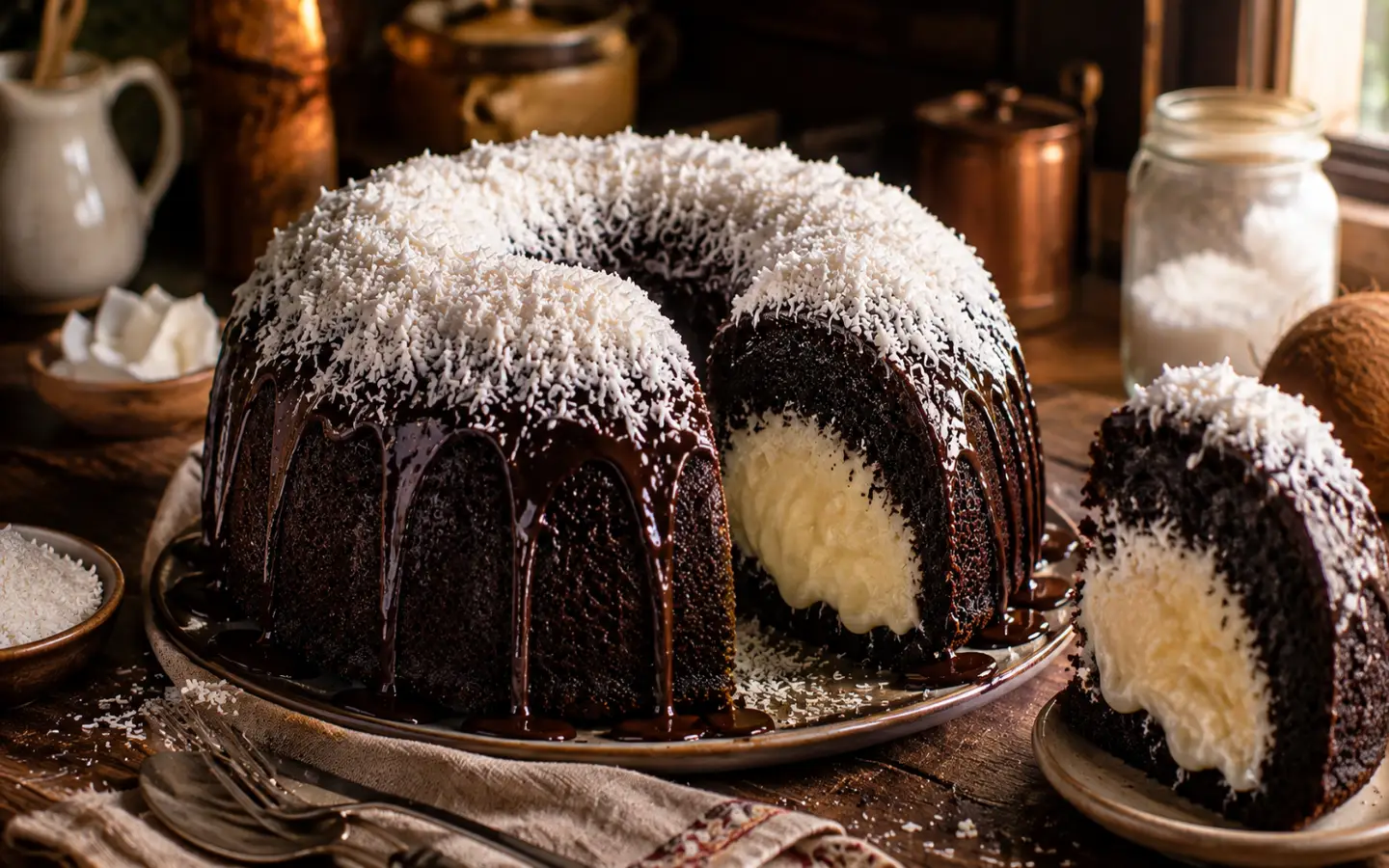
The photograph makes the argument before a single word is read. A deeply dark Bundt cake — the specific midnight black of black cocoa, darker than any standard chocolate cake — split open to reveal a white, luminous coconut custard center that fills the entire interior ring. Glossy chocolate ganache running slowly down the dark exterior. A generous blanket of white shredded coconut covering every visible surface.
The contrast is the recipe. Dark against white. Bitter against sweet. Dense fudgy crumb against silky cold custard. Glossy ganache against matte coconut. Everything in this black cocoa coconut cream pound cake exists to create and sustain that contrast, in the photograph and in every slice.
Make this for the occasion that deserves the most extraordinary dessert at the table. Make it the day before. Serve it cold, sliced at the table, so everyone sees the reveal.
“The best Southern baking is not about restraint. It is about knowing when something is already extraordinary — and then making it unforgettable.” — Claire Malin
Table of Contents
What the Photograph Is Telling You
Look at the image with attention before making this black cocoa coconut cream pound cake. Every detail is technical information.
The cake colour is the first thing. This is not dark chocolate brown. This is near-black — the specific colour that only black cocoa produces. Standard cocoa powder, even Dutch-process, produces a warm brown-to-mahogany cake. Black cocoa produces midnight. The darkness in the photograph is not a lighting choice or a filter. It is what black cocoa looks like baked into a pound cake that also contains melted semisweet chocolate. This is the correct finished colour.
The custard center is the second thing. White, luminous, filling the entire carved interior of the Bundt from the inner ring to nearly the outer wall. This is a thick coconut custard — egg yolks, cornstarch, whole milk, coconut milk, and sweetened shredded coconut, cooked until it holds its shape — packed generously into a channel carved from the underside of the cooled cake and sealed with the removed pieces before the Bundt is inverted. The white is bright because the custard is cold and the surrounding cake is the darkest possible chocolate.
The ganache is the third thing. Dark, glossy, running naturally down the ridges and grooves of the Bundt form — slow, deliberate drips rather than a thin, fast pour. The ganache should be thick enough to coat the cake surface and hold visible drip trails. The consistency in the photograph is achieved by allowing the ganache to cool for 3 to 4 minutes before pouring.
The coconut is the fourth thing. Applied immediately to the wet ganache — completely covering every surface, sitting in the grooves, covering the drip trails. The contrast between the white coconut and the dark ganache beneath it is visible at the base of the Bundt where the coconut has not fully covered the drips. This is correct. The gap is information: the ganache is thick enough to show through where the coconut coverage is thinner.
What Black Cocoa Coconut Cream Pound Cake Tastes Like
The cake itself tastes unlike any standard chocolate pound cake.
Black cocoa has a specific flavour — deeply bitter, almost Oreo-like, with an intensity and a flatness (in the best sense) that Dutch-process cocoa does not fully achieve. It tastes of dark chocolate without the sweetness, of roasted bitterness without the sharpness of natural cocoa. Combined with regular cocoa, sour cream, and melted semisweet chocolate in the batter, the result is a cake that is simultaneously intensely chocolatey and complex — not one-dimensional.
The coconut custard center tastes of vanilla and coconut and cream — cool, silky, gently sweet. Against the bitter intensity of the black cocoa crumb, the custard tastes even sweeter and more delicate than it would on its own. The contrast is not just visual. It is the flavour pairing that makes every bite of this black cocoa coconut cream pound cake more interesting than the last.
The ganache adds richness and gloss and more chocolate. The shredded coconut adds texture and fragrance and the specific sweetness of preserved coconut.
Every element is doing something different. Together they produce something that is more than the sum of the components — the definition of a recipe that earns the word extraordinary.
The 4 Components — At a Glance
| Component | Key Ingredients | What It Contributes | Critical Rule |
| Black Cocoa Pound Cake | Butter, sugar, 4 eggs, black cocoa + regular cocoa, sour cream, milk, melted chocolate | The dramatic midnight exterior — black cocoa produces the near-black colour visible in the photograph; melted chocolate and sour cream produce the dense, fudgy, exceptionally moist crumb | Bake at 325°F — lower temp prevents burning the dark batter. Do not overbake. Dense and slightly fudgy is correct. |
| Thick Coconut Custard | Whole milk, coconut milk, 4 egg yolks, cornstarch, butter, vanilla, shredded coconut | The white luminous center — a thick, cold coconut pastry cream that fills the carved channel; its whiteness creates the dramatic visual contrast with the surrounding black crumb | Must be completely cold and very thick before filling. Make it first — it needs 2+ hours to chill. Keep away from pan edges during filling. |
| Glossy Chocolate Ganache | Semisweet chocolate, heavy cream, butter | The glossy dark exterior finish — thick, slow-dripping ganache that coats the Bundt surface and runs naturally down the ridges before the coconut is applied | Cool 3–4 minutes before pouring — too hot and it runs off immediately; the right temp produces the controlled drips in the photograph. |
| Shredded Coconut Crown | 1½ to 2 cups sweetened shredded coconut | The snow-white finish that creates the full visual impact of the black cocoa coconut cream pound cake — covering all visible ganache and producing the complete dark-to-white contrast | Apply within 30 seconds of pouring the ganache — while the surface is still wet and tacky. Complete coverage is the goal. |
What Is Black Cocoa and Why It Changes Everything
Black cocoa is ultra-Dutch-processed cocoa — cocoa treated with an alkalising agent to a much higher degree than standard Dutch-process cocoa.
The treatment strips nearly all of the acidity from the cocoa and produces a powder that is almost black in colour, with a flavour that is deeply bitter, smooth, and intensely chocolatey. It is the cocoa used in Oreo cookies. It produces baked goods that are a striking near-black rather than the warm brown of standard chocolate baking.
In this black cocoa coconut cream pound cake, black cocoa is used alongside regular unsweetened cocoa rather than alone. Black cocoa alone can produce a dry, very dense texture because of its low fat content — the regular cocoa adds back some of the fat and acidity that balances the batter.
Black cocoa is available at specialty baking shops, natural food stores, and online — King Arthur Baking Company sells a widely available version. It cannot be substituted with standard cocoa or Dutch-process cocoa for this recipe: the colour, the flavour, and the specific visual identity of the finished cake all depend on it.
The melted semisweet chocolate in the batter is the second source of chocolate flavour — it adds richness and a different flavour dimension than the cocoa alone, contributing to the fudgy, dense texture of the crumb.
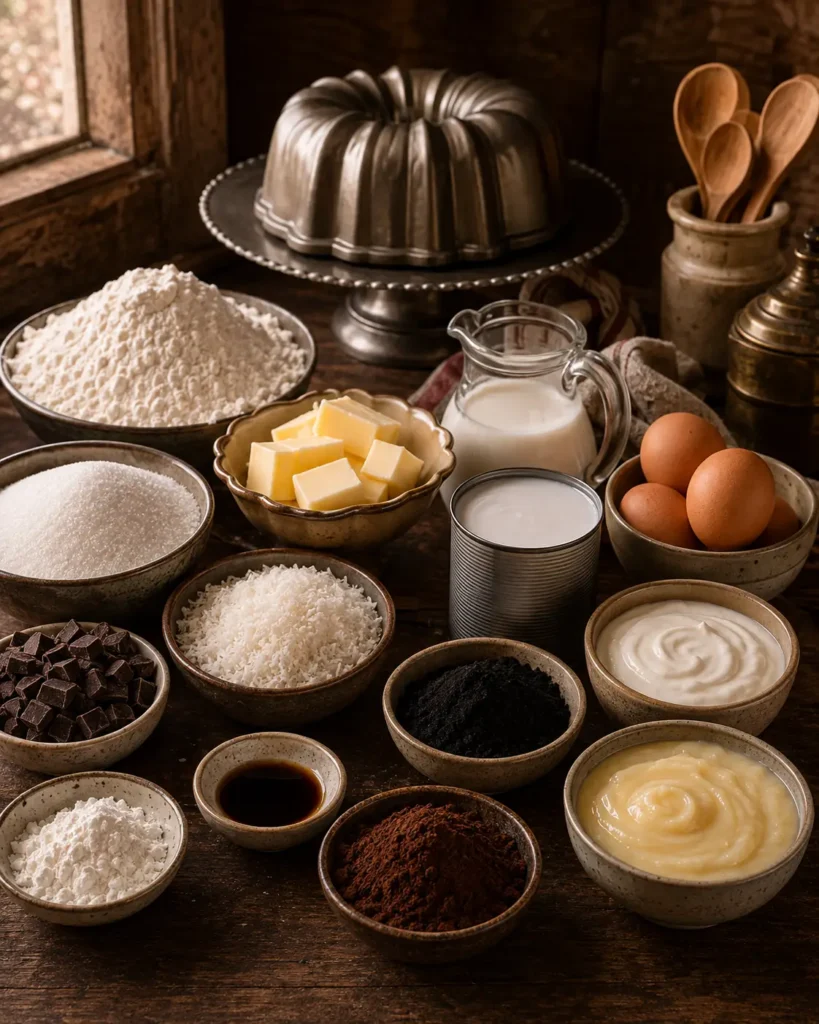
All Ingredients — Everything You Need
Serves 12–14 | Prep: 40 min | Bake: 65–75 min | Chill: 2 hrs | Total: ~4 hrs | 325°F / 165°C
For the Black Cocoa Pound Cake:
- 1 cup (225g) unsalted butter, softened to room temperature
- 2 cups (400g) granulated sugar
- 4 large eggs, at room temperature
- 2 teaspoons pure vanilla extract
- 2 cups (250g) all-purpose flour
- ¾ cup (68g) black cocoa powder — not substitutable
- ¼ cup (22g) regular unsweetened cocoa powder
- 1 teaspoon baking powder
- ½ teaspoon baking soda
- ½ teaspoon fine salt
- 1 cup (240g) full-fat sour cream
- ½ cup (120ml) whole milk
- ½ cup (88g) semisweet chocolate chips, melted and slightly cooled
For the Thick Coconut Custard Center:
- 1½ cups (360ml) whole milk
- ¾ cup (180ml) full-fat canned coconut milk — well stirred
- ½ cup (100g) granulated sugar
- 4 large egg yolks
- ¼ cup (28g) cornstarch
- Pinch of fine salt
- 2 tablespoons unsalted butter
- 1 teaspoon pure vanilla extract
- 1 cup (90g) sweetened shredded coconut — stirred in after cooking
For the Glossy Chocolate Ganache:
- 1 cup (175g) semisweet chocolate, finely chopped
- ¾ cup (180ml) heavy cream
- 1 tablespoon unsalted butter
For the Coconut Crown:
- 1½ to 2 cups (135–180g) sweetened shredded coconut — applied immediately to wet ganache
How to Make It — Step by Step
Make the coconut custard first — it needs at least 2 hours to chill. Everything else follows from there.
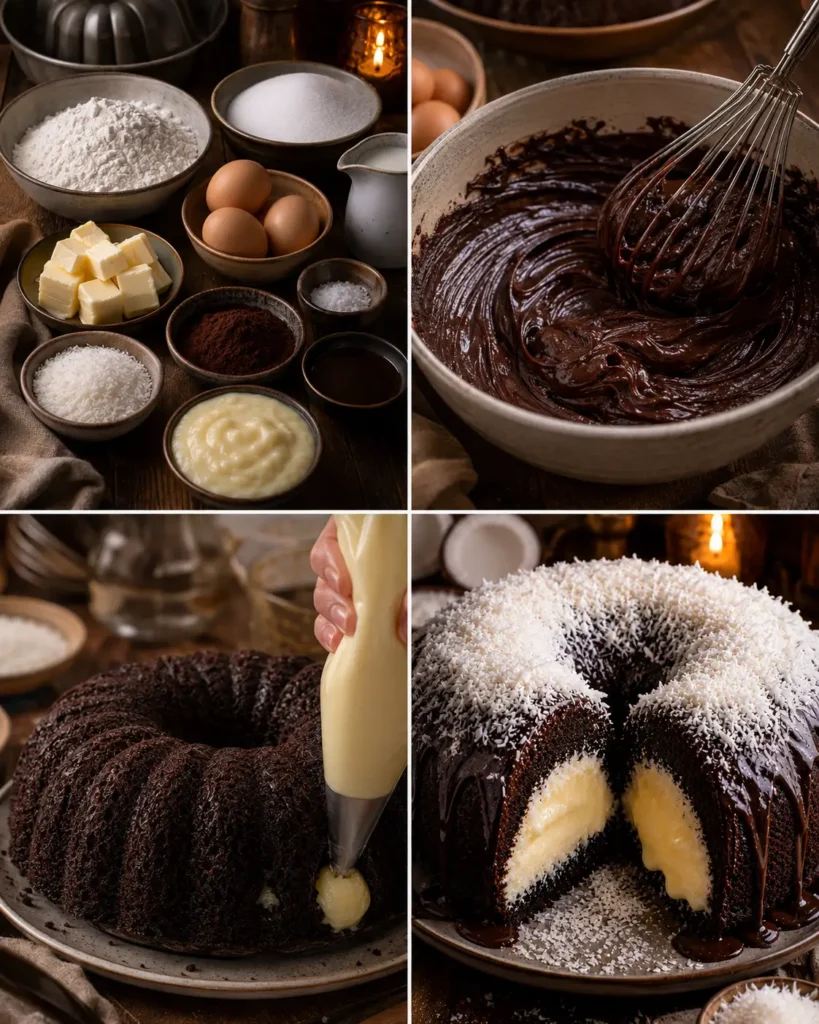
Step 1 — Make the coconut custard (start here).
Heat the whole milk and coconut milk together in a saucepan until steaming but not boiling.
In a bowl, whisk the granulated sugar, egg yolks, cornstarch, and salt until smooth and slightly pale.
Slowly pour about one-third of the hot milk mixture into the yolk mixture while whisking constantly — this tempers the eggs.
Return everything to the saucepan. Cook over medium-low heat, whisking continuously, until the custard is very thick, smooth, and holds a trail when the whisk is lifted — 4 to 6 minutes.
Cook 30 additional seconds after the first bubbles appear.
Remove from heat. Whisk in the butter and vanilla. Fold in the shredded coconut.
Transfer to a bowl, press plastic wrap directly onto the surface, and refrigerate until completely cold and very thick — at least 2 hours, overnight preferred.
Step 2 — Prepare the Bundt pan.
Preheat the oven to 325°F (165°C).
Grease a 10 to 12-cup Bundt pan thoroughly with softened butter using a pastry brush — every groove.
Dust with flour, tilt to coat every surface, tap out the excess.
Black cocoa batter is particularly prone to sticking. This step determines whether the cake releases cleanly.
Step 3 — Make the black cocoa batter.
Whisk the flour, black cocoa, regular cocoa, baking powder, baking soda, and salt together in a medium bowl.
In a separate small bowl or jug, stir the sour cream and whole milk together until smooth.
Beat the softened butter and granulated sugar on medium-high speed for 4 to 5 minutes — until the mixture is pale and significantly increased in volume.
Add the eggs one at a time, beating well after each. Add the vanilla.
With the mixer on low, add the flour mixture in three additions alternating with the sour cream mixture, beginning and ending with the flour.
Fold in the melted, slightly cooled semisweet chocolate with a rubber spatula until just combined.
Step 4 — Bake.
Spoon the batter into the prepared Bundt pan and smooth the top.
Bake at 325°F for 65 to 75 minutes.
Test at 65 minutes: a skewer inserted into the cake portion should come out with a few moist crumbs — not raw batter, not completely clean.
The correct crumb is dense, slightly fudgy, and moist. Do not bake to a dry, clean-skewer result.
Cool in the pan for 15 minutes. Invert onto a wire rack and cool completely — at least 1 hour.
Step 5 — Carve the hidden custard channel.
Turn the completely cooled Bundt cake upside down so the flat base faces upward.
Using a sharp serrated knife, carefully cut a deep circular channel into the underside — following the Bundt ring, leaving approximately ¾ inch of cake on all sides and at the bottom.
Remove the carved cake pieces carefully and set them aside on a plate. The channel should be deep and wide enough to hold a generous amount of filling.
Step 6 — Fill with coconut custard.
The custard must be completely cold and very thick before this step.
Spoon or pipe the cold coconut custard into the channel, packing it firmly and generously all the way around the ring.
The custard should fill the channel completely and be level with the carved opening.
Trim the reserved cake pieces as needed and place them back over the custard to seal the channel completely.
Press gently to secure. Refrigerate for 1 hour.
Step 7 — Invert and prepare for the ganache.
After the 1-hour chill, carefully place the serving plate over the sealed bottom of the inverted cake.
Flip the cake right-side up onto the serving plate.
The custard-filled channel is now hidden inside the Bundt, invisible from the outside.
Step 8 — Make the chocolate ganache.
Place the finely chopped semisweet chocolate in a heatproof bowl.
Heat the heavy cream in a small saucepan until steaming — not boiling.
Pour the hot cream over the chocolate. Let stand for 2 minutes without stirring.
Add the butter. Stir from the centre outward until completely smooth and glossy.
Allow to cool for 3 to 4 minutes until thickened slightly — it should fall from a spoon in a slow, controlled stream.
Step 9 — Pour ganache and apply coconut crown.
Pour the ganache slowly and generously over the top of the Bundt, starting at the centre of the ring.
Allow it to run naturally down the ridges and sides.
Immediately — within 30 seconds — apply the shredded coconut over the entire surface while the ganache is still wet.
Press gently to anchor. Cover every visible surface completely.
Refrigerate for 30 to 60 more minutes until the ganache is set.
Step 10 — Slice and reveal.
Use a warm, sharp knife — dipped in hot water and wiped dry before every cut.
Slice at the table so the reveal happens in front of everyone.
Each slice should show: deep black cake exterior, white luminous coconut custard center, and the contrast of the ganache and coconut on the surface.
That moment is what the recipe was built for.
Claire’s Essential Tips
On black cocoa:
Black cocoa is not interchangeable with standard or Dutch-process cocoa in this recipe. The colour, flavour, and visual identity of the finished cake depend on it. King Arthur Baking Company’s Bensdorp black cocoa is widely available online and in specialty stores.
On baking temperature:
325°F is correct for this cake — lower than standard pound cake temperature. Black cocoa batter browns very quickly at higher temperatures, and the exterior can appear done before the interior is baked through. The lower temperature produces an even bake throughout the dense batter.
On the custard channel:
Work slowly and carefully when carving the channel. The goal is a generous, even channel around the full ring of the Bundt, leaving consistent cake walls on all sides. An uneven channel produces uneven custard distribution — some slices will have more custard than others.
On the custard temperature:
The custard must be cold — genuinely, refrigerator-cold — before it goes into the channel. Warm custard will seep into the surrounding crumb rather than staying in a distinct, defined center. Overnight refrigeration is the most reliable approach.
On the ganache timing:
3 to 4 minutes of cooling after making the ganache produces the right pouring consistency. Too hot and it runs off the cake before the coconut can be applied. Too cool and it sets in patches rather than flowing smoothly. Test the consistency by lifting the spoon — it should fall in a slow, controlled ribbon.
On the coconut application:
Within 30 seconds of pouring the ganache. This is the rule that applies to every coconut-topped cake in this collection: the coconut adheres to wet ganache and slides off set ganache. Have the coconut measured and ready before the ganache is poured.
On the occasion:
Claire Malin makes this black cocoa coconut cream pound cake for the gatherings where the dessert table is expected to produce a moment. The reveal — the first slice cut at the table, the white custard visible against the black cake — is reliably the moment of the evening. Make it for those evenings. Make it the day before. Serve it cold.
6 Rules for the Perfect Result
| The Rule | Why It Matters |
| Use black cocoa — no substitutes | Standard or Dutch-process cocoa produces a brown-to-dark-brown cake. Only black cocoa produces the near-midnight colour in the photograph. The visual identity of this recipe depends on it. |
| Chill custard overnight | Cold custard holds its shape in the channel. Warm custard seeps into the surrounding crumb and loses its defined white center — which is the entire visual and flavour argument for making this cake. |
| Do not overbake | The correct crumb is dense and slightly fudgy. A dry, fully-baked-through result loses the moisture and richness that makes the cake what it is. Pull at the first few-moist-crumbs result. |
| Cool ganache 3–4 minutes before pouring | Hot ganache runs straight off the cake without coating. Room-temperature ganache is too thick to drip. 3 to 4 minutes produces the slow, controlled pour visible in the photograph. |
| Apply coconut within 30 seconds | The ganache begins to set a skin within minutes. Coconut applied to set ganache does not adhere and slides off when sliced. Have it measured and ready before the ganache is poured. |
| Slice with a warm knife | A cold or dry knife drags through the coconut topping and compresses the ganache, producing ragged slices. A warm, clean knife glides through all layers cleanly — producing the cross-section visible in the photograph. |
Variations Worth Making
Dark chocolate espresso version: add 1 tablespoon of instant espresso powder to the dry ingredients alongside the black cocoa. The espresso deepens the chocolate flavour significantly and adds a bitter complexity that makes the contrast with the sweet coconut custard even more pronounced. This is the most sophisticated direction this recipe can take.
White chocolate ganache: replace the semisweet chocolate ganache with a white chocolate ganache — 1 cup of finely chopped white chocolate poured with ¾ cup of hot heavy cream and 1 tablespoon of butter. The white chocolate ganache produces a completely different visual: pale gold against the black cake, with the coconut crown visible as white-against-white. A subtler version that is equally striking.
Raspberry coconut custard: add 2 tablespoons of raspberry jam or fresh raspberry coulis to the coconut custard after it is fully cooked and cooled. The raspberry turns the custard a pale pink-white and adds a tart note that cuts through the sweetness of the coconut and the richness of the black cocoa crumb. The visual at the cut edge — deep black cake, pale pink custard — is equally dramatic as the original.
How to Serve It
- Cold, directly from the refrigerator — the ganache is set, the coconut is anchored, and the custard is at its most defined and sliceable
- Sliced at the table with a warm knife — the reveal of the white custard center against the black crumb is the moment the recipe is built for
- With a small spoon of extra custard or warm chocolate sauce on the plate alongside each slice
- With vanilla ice cream for the most indulgent version — cold ice cream against the cold black cocoa crumb is the best possible contrast
- As the centrepiece of any celebration table where the dessert is expected to produce a moment
- The day after making — the flavours deepen overnight and the custard center firms to its cleanest, most distinct consistency
Storage
The black cocoa coconut cream pound cake keeps covered in the refrigerator for up to 4 days.
The ganache sets firm and the coconut softens slightly as it absorbs moisture from the ganache surface — this is a texture change, not a quality issue. The custard center remains defined and creamy through the full storage window.
Make-ahead: the custard can be made up to 2 days ahead. The cake can be baked and cooled a day ahead, filled, and refrigerated overnight before the ganache and coconut are applied the following day.
Do not freeze the assembled cake — the custard filling and ganache both change texture on thawing. Individual unfilled cake slices can be frozen for up to 1 month.
For guidance on food-safe handling of egg-based custard preparations, the USDA food safety resource at foodsafety.gov provides current recommendations on storage temperatures and times.
A Final Word from the Southern Bites Kitchen
There are recipes that make good food and there are recipes that make moments.
The black cocoa coconut cream pound cake is the second kind. The first slice cut at the table — the white custard appearing against the black crumb, the ganache still slightly soft, the coconut covering every surface — produces the kind of silence that the best desserts produce. Not because anyone is being dramatic about it. Because the cake is genuinely extraordinary and everyone at the table knows it.
Make it for those evenings. Make it the day before so the custard is cold and the ganache is set and the coconut is anchored and everything is exactly right when the first slice is cut.
That moment is worth every hour the kitchen asked of you.
Faq’s
What is black cocoa and where can I buy it?
Black cocoa is ultra-Dutch-processed cocoa that produces a near-black colour and a deeply bitter, smooth flavour — it is the cocoa used in Oreo cookies. It cannot be substituted with standard or Dutch-process cocoa for this recipe. King Arthur Baking Company sells a widely available black cocoa powder online and in specialty baking shops.
How do I keep the coconut custard center from disappearing into the cake?
Two things: the custard must be completely cold and very thick before it goes into the carved channel, and the channel must be cut with ¾ inch of cake remaining on all sides so the custard is fully enclosed. Cold custard holds its shape. Warm custard seeps into the surrounding crumb and loses its white, defined appearance.
Can black cocoa coconut cream pound cake be made ahead?
Yes — and it is strongly recommended. The custard can be made 2 days ahead. The cake can be baked, filled, and refrigerated overnight. The ganache and coconut can be applied the following day. The fully assembled cake keeps refrigerated for up to 4 days.
Why does this recipe bake at 325°F instead of 350°F?
Black cocoa batter is very dark and appears done before the interior is fully baked at higher temperatures. 325°F produces an even bake throughout the dense batter without over-browning the exterior. The extended bake time at lower temperature also contributes to the moist, slightly fudgy crumb.
Black Cocoa Coconut Cream Pound Cake

Equipment
- Saucepan
- Mixing Bowls
- Whisk
- 10 to 12-cup Bundt pan
- Pastry brush
- electric mixer
- small bowl or jug
- Rubber spatula
- Wire Rack
- sharp serrated knife
- Serving plate
- heatproof bowl
Ingredients
- 1 cup unsalted butter, softened to room temperature (225g)
- 2 cups granulated sugar (400g)
- 4 large eggs, at room temperature
- 2 teaspoons pure vanilla extract
- 2 cups all-purpose flour (250g)
- ¾ cup black cocoa powder — not substitutable (68g)
- ¼ cup regular unsweetened cocoa powder (22g)
- 1 teaspoon baking powder
- ½ teaspoon baking soda
- ½ teaspoon fine salt
- 1 cup full-fat sour cream (240g)
- ½ cup whole milk (120ml)
- ½ cup semisweet chocolate chips, melted and slightly cooled (88g)
- 1½ cups whole milk (360ml)
- ¾ cup full-fat canned coconut milk, well stirred (180ml)
- ½ cup granulated sugar (100g)
- 4 large egg yolks
- ¼ cup cornstarch (28g)
- 1 pinch fine salt
- 2 tablespoons unsalted butter
- 1 teaspoon pure vanilla extract
- 1 cup sweetened shredded coconut, stirred in after cooking (90g)
- 1 cup semisweet chocolate, finely chopped (175g)
- ¾ cup heavy cream (180ml)
- 1 tablespoon unsalted butter
- 1½–2 cups sweetened shredded coconut, applied immediately to wet ganache (135–180g)
Instructions
- Heat the whole milk and coconut milk together in a saucepan until steaming but not boiling. In a bowl, whisk the granulated sugar, egg yolks, cornstarch, and salt until smooth and slightly pale. Slowly pour about one-third of the hot milk mixture into the yolk mixture while whisking constantly to temper the eggs. Return everything to the saucepan and cook over medium-low heat, whisking continuously, until the custard is very thick, smooth, and holds a trail when the whisk is lifted, 4 to 6 minutes. Cook 30 additional seconds after the first bubbles appear. Remove from heat, whisk in the butter and vanilla, then fold in the shredded coconut. Transfer to a bowl, press plastic wrap directly onto the surface, and refrigerate until completely cold and very thick, at least 2 hours, overnight preferred.
- Preheat the oven to 325°F (165°C). Grease a 10 to 12-cup Bundt pan thoroughly with softened butter using a pastry brush, coating every groove. Dust with flour, tilt to coat every surface, and tap out the excess. Black cocoa batter is particularly prone to sticking, so thorough pan preparation is essential.
- Whisk the flour, black cocoa, regular cocoa, baking powder, baking soda, and salt together in a medium bowl. In a separate small bowl or jug, stir the sour cream and whole milk together until smooth. Beat the softened butter and granulated sugar on medium-high speed for 4 to 5 minutes until pale and significantly increased in volume. Add the eggs one at a time, beating well after each, then add the vanilla. With the mixer on low, add the flour mixture in three additions alternating with the sour cream mixture, beginning and ending with the flour. Fold in the melted, slightly cooled semisweet chocolate with a rubber spatula until just combined.
- Spoon the batter into the prepared Bundt pan and smooth the top. Bake at 325°F for 65 to 75 minutes. Test at 65 minutes: a skewer inserted into the cake portion should come out with a few moist crumbs, not raw batter and not completely clean. The correct crumb is dense, slightly fudgy, and moist. Cool in the pan for 15 minutes, invert onto a wire rack, and cool completely for at least 1 hour.
- Turn the completely cooled Bundt cake upside down so the flat base faces upward. Using a sharp serrated knife, carefully cut a deep circular channel into the underside, following the Bundt ring and leaving approximately ¾ inch of cake on all sides and at the bottom. Remove the carved cake pieces carefully and set them aside on a plate. The channel should be deep and wide enough to hold a generous amount of filling.
- Make sure the custard is completely cold and very thick. Spoon or pipe the cold coconut custard into the channel, packing it firmly and generously all the way around the ring. Fill the channel completely and level it with the carved opening. Trim the reserved cake pieces as needed and place them back over the custard to seal the channel completely. Press gently to secure, then refrigerate for 1 hour.
- After the 1-hour chill, carefully place the serving plate over the sealed bottom of the inverted cake. Flip the cake right-side up onto the serving plate. The custard-filled channel should now be hidden inside the Bundt and invisible from the outside.
- Place the finely chopped semisweet chocolate in a heatproof bowl. Heat the heavy cream in a small saucepan until steaming but not boiling. Pour the hot cream over the chocolate and let stand for 2 minutes without stirring. Add the butter and stir from the centre outward until completely smooth and glossy. Allow to cool for 3 to 4 minutes until slightly thickened and able to fall from a spoon in a slow, controlled stream.
- Pour the ganache slowly and generously over the top of the Bundt, starting at the centre of the ring, and allow it to run naturally down the ridges and sides. Immediately, within 30 seconds, apply the shredded coconut over the entire surface while the ganache is still wet. Press gently to anchor and cover every visible surface completely. Refrigerate for 30 to 60 minutes until the ganache is set.
- Use a warm, sharp knife dipped in hot water and wiped dry before every cut. Slice at the table so each piece reveals the deep black cake exterior, white luminous coconut custard center, glossy ganache, and shredded coconut topping.
Notes
Nutrition
More Southern recipes worth savoring — timeless classics, grandmother’s kitchen secrets, and Claire Malin’s own take on the flavors that have always called the South home. astrorecipes.com/category/southern-bites/
and on our Facebook page:https://www.facebook.com/astrorecipes1
Recipes I Think You’ll Love