

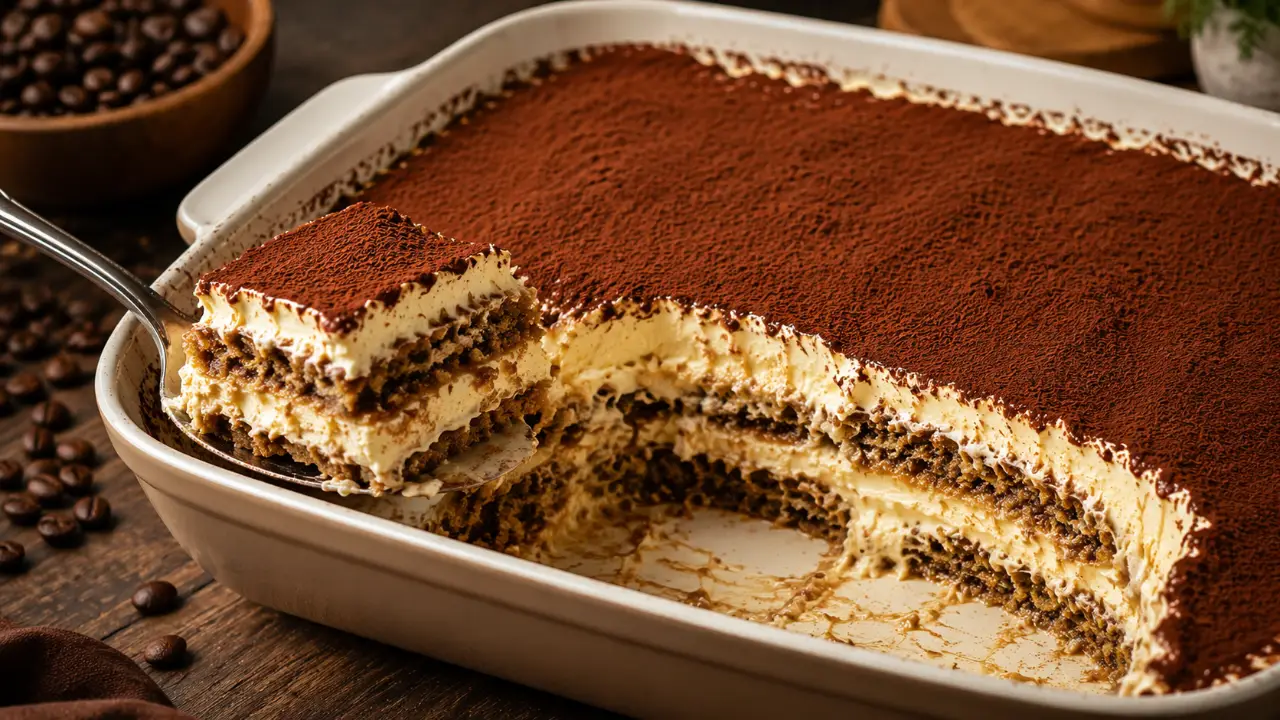
Creamy, Classic, Built for Twelve. The One That Earns Its Name at Every Table.
Prep 25 min • Chill 6 hours or overnight • Serves 12 • No baking required
Nora Piket has eaten tiramisu in the kind of restaurants that understand what it is supposed to be — the ones where it arrives in a small ceramic dish, barely set, dusted heavily in cocoa, the mascarpone cream so light and cold and coffee-dark at the edges that it is difficult to decide whether to eat it slowly or all at once. She has eaten versions that were too sweet, too stiff, too pale, too much like something assembled in a hurry by someone who had never eaten the real thing. She has a very clear opinion about which version is worth making.
This tiramisu casserole is the version worth making. Not the restaurant ceramic dish — the casserole version, the one for twelve, the one that lives in a 9×13-inch baking dish in the refrigerator overnight and arrives at the table the following evening looking exactly right: cocoa-dusted, thick-creamed, the ladyfinger layers visible at the cut edge in their coffee-soaked entirety. The version that serves a crowd without asking the cook to pipe anything, temper anything, or watch a thermometer.
The word casserole does something to the imagination that the recipe does not deserve. It suggests something assembled rather than crafted, something practical rather than considered. This tiramisu is both — it is assembled, yes, and practically made, certainly, and it is also one of the most deeply satisfying desserts in this entire collection. Creamy, rich, soft, and unbelievably comforting, the recipe’s own description puts it, and every word of that is accurate.
“A recipe isn’t just instructions. It’s an invitation to live in the moment you’re cooking for.” — Nora Piket
Table of Contents
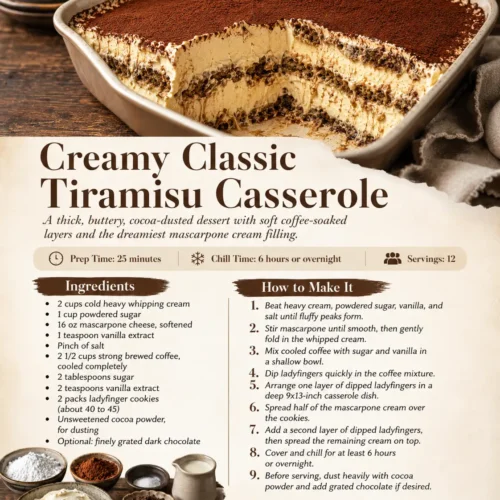
Tiramisu Casserole

Equipment
- 9×13-inch deep casserole dish
- Large mixing bowl
- electric mixer with whisk attachment
- Rubber spatula
- shallow bowl Wide enough to dip ladyfingers horizontally.
- fine-mesh sieve For dusting cocoa powder.
- offset spatula or large spoon
Ingredients
- 2 cups cold heavy whipping cream
- 1 cup powdered sugar, sifted
- 16 oz full-fat mascarpone cheese, softened to room temperature
- 1 tsp pure vanilla extract
- 1 pinch fine salt
- 2½ cups strong brewed coffee, espresso-strength preferred and cooled completely
- 2 tbsp granulated sugar
- 2 tsp pure vanilla extract
- 2 packs ladyfinger cookies (savoiardi), about 40 to 45 cookies total
- unsweetened cocoa powder, for generous dusting before serving
- finely grated dark chocolate (70% cocoa or above), optional
Instructions
- In a chilled bowl, beat the cold heavy cream, sifted powdered sugar, vanilla extract, and pinch of salt on medium-high speed until thick, fluffy peaks form. Do not overwhip. Set aside in the refrigerator while preparing the mascarpone.
- In a large bowl, stir the softened mascarpone with a rubber spatula until smooth, creamy, and completely lump-free. Do not use a mixer at high speed.
- Add the whipped cream to the mascarpone in two or three additions, folding gently after each addition. Stop as soon as the filling is uniform and no white streaks remain.
- In a shallow bowl wide enough for a ladyfinger, combine the cooled coffee with the sugar and vanilla extract. Stir until the sugar dissolves.
- Dip each ladyfinger into the coffee mixture for approximately 2 seconds per side, then immediately transfer it to a deep 9×13-inch casserole dish. Arrange the dipped ladyfingers in a tight, even layer across the bottom.
- Spread exactly half of the mascarpone cream over the ladyfinger layer in an even, generous coat. Create soft swirls with the back of a spoon or an offset spatula, covering every ladyfinger completely.
- Repeat the dipping and layering process with the remaining ladyfingers, then spread the remaining mascarpone cream over the top with soft swirls.
- Cover the dish tightly with plastic wrap pressed against the cream surface, or use a fitted lid. Refrigerate for at least 6 hours; overnight is preferred.
- Immediately before serving, use a fine-mesh sieve to dust the entire surface heavily with unsweetened cocoa powder. Add finely grated dark chocolate if using, then scoop deeply and serve immediately.
Notes
Nutrition
What Tiramisu Casserole Tastes Like
The flavours are the classic ones, because tiramisu’s flavours are correct and have always been correct. Strong coffee. Mascarpone — the real thing, full-fat, cold when it goes into the cream, soft and rich and slightly tangy in the way that only mascarpone is. Vanilla. A heavy hand of cocoa across the top that turns every spoonful into something that is simultaneously dessert and the memory of an Italian afternoon.
The texture is what distinguishes a tiramisu casserole made properly from one made in a hurry. The ladyfingers, dipped quickly in the sweetened coffee — very quickly, a second or two per cookie, no more — absorb just enough liquid to become soft and yielding while retaining enough structure to hold their position in the layers. After six hours in the refrigerator, and better still after overnight, they have become something that is no longer a cookie and not quite a cake — a soft, dark, coffee-soaked layer that is exactly what tiramisu’s middle is supposed to be.
The mascarpone cream, folded together from whipped cream and softened mascarpone, is thick and airy and settles over the ladyfinger layers without weeping or collapsing. It does not taste of sugar alone. It tastes of cream and vanilla and the subtle tang of good mascarpone and the cocoa that dusts through it from the top. It is the kind of cream that makes every spoonful feel like the cook knew something.
Scoop deeply when you serve it. Get all three components — cocoa top, mascarpone cream, coffee-soaked ladyfinger — in one spoonful. This is not negotiable.
Why the Casserole Format Works
Traditional tiramisu is portioned individually, or assembled in a springform pan and sliced, or made in a deep dish and served by the spoonful. All of these are correct. The casserole format — a 9×13-inch dish, two full layers, twelve generous servings — is the version for gatherings, for the table that needs a make-ahead dessert that requires no day-of attention, for any occasion where a dessert needs to serve twelve and look like someone spent real time on it.
The practical advantages are significant. The casserole tiramisu is assembled in full the night before, refrigerated overnight, and brought to the table the following evening needing only a dusting of cocoa powder added at the last moment. There is no last-minute whipping, no just-before-serving assembly, no holding the dessert in a state of semi-completion while the rest of the meal finishes. It is made, it chills, and it is ready when you are.
The overnight chill is also a flavour advantage, not just a practical one. Six hours produces a good tiramisu. Twelve hours produces a remarkable one — the coffee has fully permeated the ladyfinger layers, the mascarpone cream has set into something firm and sliceable, and the flavours of coffee, mascarpone, and cocoa have stopped being separate elements and started being a single coherent thing. This integration is what distinguishes a properly rested tiramisu from one assembled and served the same day.
Understanding the Three Components
The Mascarpone Cream
This is the heart of the tiramisu. Cold heavy cream whipped to thick, fluffy peaks, then folded — not beaten, not stirred, folded — into softened mascarpone that has been stirred smooth with powdered sugar, vanilla, and a pinch of salt. The result is a filling that is simultaneously airy and rich — lighter than a cheesecake filling, denser than whipped cream, and flavoured in a way that is specifically and unmistakably tiramisu.
Two technique points that determine the quality of the finished cream. First: the mascarpone must be genuinely softened — taken from the refrigerator 30 to 45 minutes before use — so that it stirs smooth without lumps. Cold mascarpone will not combine smoothly with the whipped cream and produces a curdled-looking filling. Second: the fold must be gentle. The air in the whipped cream is the lightness of the filling. Overmixing deflates it. Two or three passes with a rubber spatula, each one deliberate, until no white streaks remain. Stop there.
The Coffee Soak
Strong brewed coffee — genuinely strong, espresso-strength if possible, not weak drip coffee — cooled completely, sweetened with a little sugar and vanilla. This is the soaking liquid for the ladyfingers, and the quality of the coffee determines the depth of flavour in the finished tiramisu. Use the best coffee you brew. Make it strong. Cool it fully before using — warm coffee soaks the ladyfingers too quickly and unevenly.
The dipping technique is where most tiramisu goes wrong. Too long in the coffee and the ladyfinger falls apart in your hands before it reaches the dish. Too short and the interior remains dry and dusty, unaffected by the soak. The correct duration is approximately two seconds per side — a brief dip, a moment to absorb, out. The ladyfinger should be damp on the surface and slightly soft but still hold its shape. It will absorb further as it chills, and the overnight chill takes it the rest of the way to the soft, yielding layer the finished tiramisu needs.
The Cocoa Dusting
Unsweetened cocoa powder, applied generously through a fine-mesh sieve immediately before serving. Not in advance — the cocoa absorbs moisture from the cream surface and turns from a dry, matte dusting into a wet, dark film if applied hours before serving. Dust just before the dish goes to the table. Use unsweetened cocoa — Dutch-process for a darker, smoother flavour; natural cocoa for a sharper, more acidic note. Either is correct. Heavy is correct. The cocoa should cover the entire surface with visible depth, not a token sprinkle.
What You Will Need
Serves 12 | Prep: 25 min | Chill: 6 hours minimum, overnight preferred | No baking required
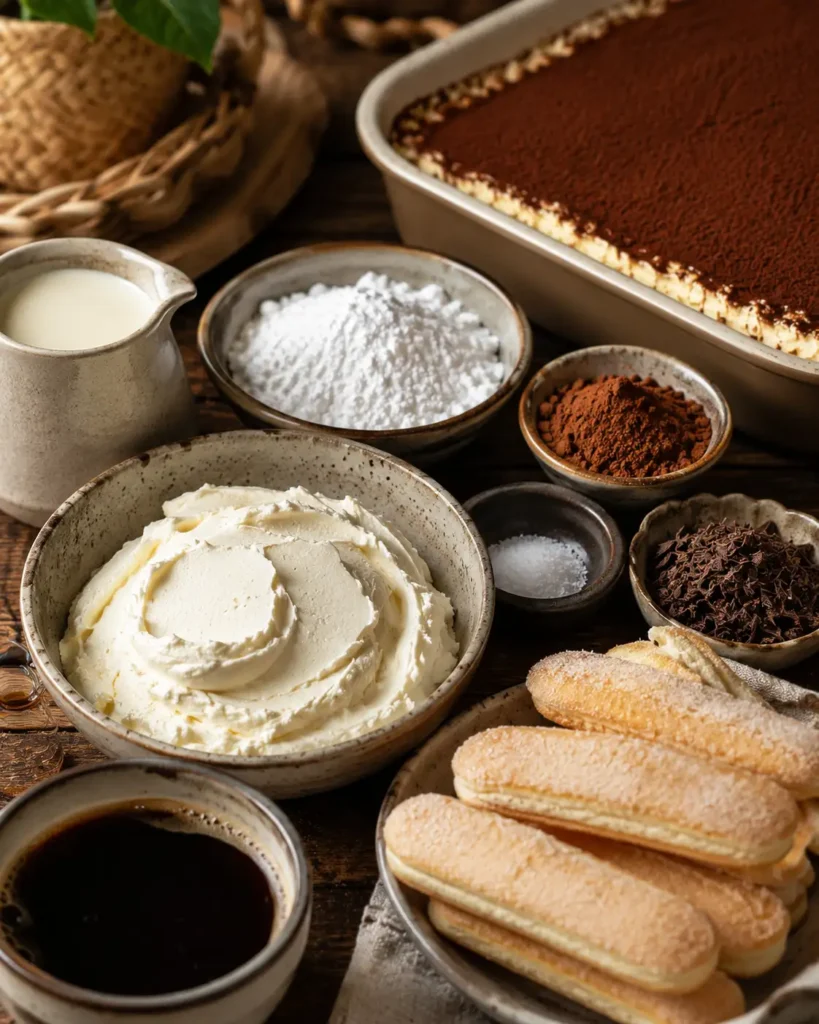
For the Mascarpone Cream:
- 2 cups (480ml) cold heavy whipping cream
- 1 cup (120g) powdered sugar, sifted
- 16 oz (450g) full-fat mascarpone cheese, softened to room temperature
- 1 teaspoon pure vanilla extract
- Pinch of fine salt
For the Coffee Layers:
- 2½ cups (600ml) strong brewed coffee — espresso-strength preferred; cooled completely
- 2 tablespoons granulated sugar
- 2 teaspoons pure vanilla extract
- 2 packs ladyfinger cookies (savoiardi) — about 40 to 45 cookies total
For the Top:
- Unsweetened cocoa powder — generously applied through a fine-mesh sieve just before serving
- Optional: finely grated dark chocolate (70% cocoa or above) — for extra richness and visual texture
How to Make It
Before you begin: remove the mascarpone from the refrigerator 30 to 45 minutes ahead of assembly. Brew the coffee at least an hour before, so it has time to cool completely. Sift the powdered sugar. Cold cream in a cold bowl whips best — refrigerate the bowl and whisk attachment for 10 minutes before starting.
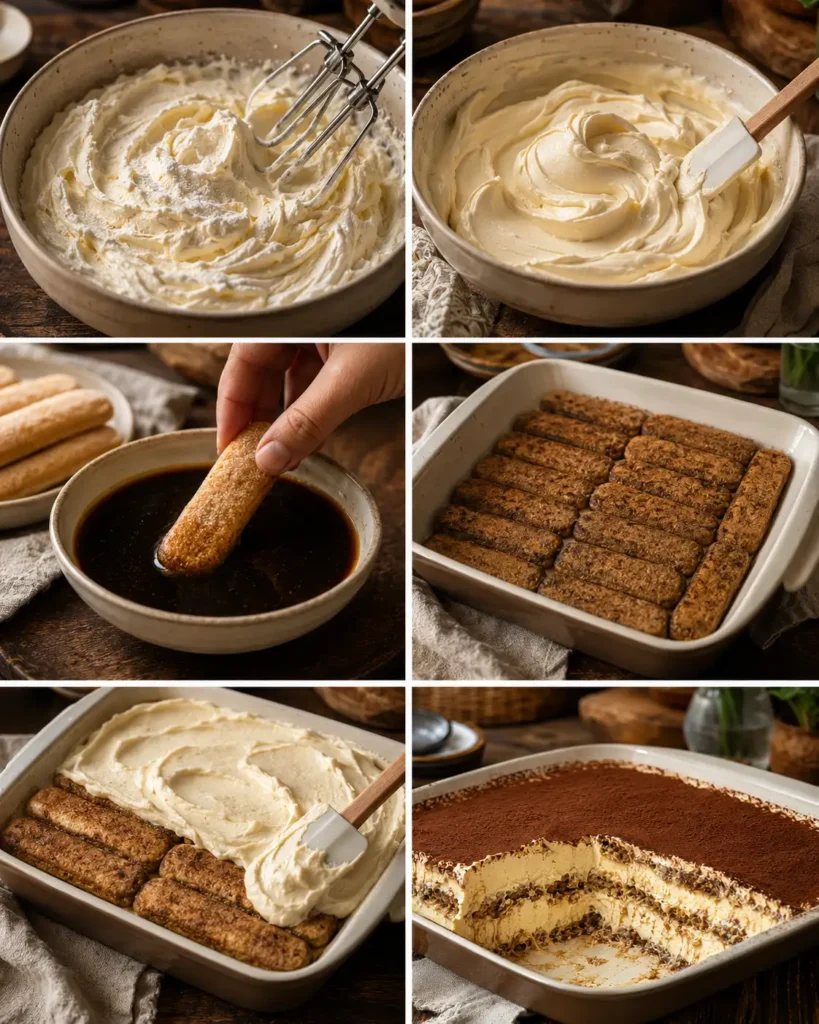
Step 1 — Whip the cream.
In the chilled bowl, beat the cold heavy cream, sifted powdered sugar, vanilla extract, and pinch of salt on medium-high speed until thick, fluffy peaks form. The cream should hold its shape firmly when the whisk is lifted and not slump. Do not overwhip to a grainy or butter-like consistency. Set aside in the refrigerator while you prepare the mascarpone.
Step 2 — Make the mascarpone base.
In a large bowl, stir the softened mascarpone with a rubber spatula until it is smooth, creamy, and completely lump-free. This step requires the mascarpone to be genuinely soft — take the time. A few minutes of gentle stirring produces a silky, uniform base. Do not use a mixer at high speed, which can cause mascarpone to break and become grainy.
Step 3 — Fold the cream into the mascarpone.
Add the whipped cream to the mascarpone in two or three additions, folding gently with the rubber spatula after each. Use slow strokes — from the bottom of the bowl upward and over — and stop the moment the filling is uniform and no white streaks remain. The finished cream should be thick, airy, billowed, and hold a soft peak when lifted. Taste it. It should be lightly sweet, vanilla-forward, and rich without being cloying. If it needs more vanilla, add a few drops now.
Step 4 — Make the coffee soak.
In a shallow bowl wide enough to dip a ladyfinger horizontally, combine the cooled coffee with the sugar and vanilla extract. Stir to dissolve the sugar. The bowl should be shallow enough that the ladyfinger dips in without submerging fully — you want to control the soak.
Step 5 — Dip and layer.
Work efficiently. Dip each ladyfinger into the coffee mixture for approximately two seconds per side — hold it by one end, dip one side, flip, dip the other, immediately transfer to the baking dish. Arrange the dipped ladyfingers in a single, tight layer across the bottom of a deep 9×13-inch casserole dish. Pack them closely; any gaps will show in the finished tiramisu when served. If you need to break ladyfingers to fill corners, do so without ceremony.
Step 6 — First cream layer.
Spread exactly half the mascarpone cream over the ladyfinger layer in an even, generous coat. Use the back of a large spoon or an offset spatula to create soft, gentle swirls across the surface — not peaks that might dry out, but soft undulations that look abundant and intentional. The cream should cover every ladyfinger completely.
Step 7 — Second layer.
Repeat the dipping and layering process with the remaining ladyfingers, placing them in a tight, even layer over the cream. Then spread the remaining mascarpone cream over the top, again generously, again with soft swirls. The surface should be thick and creamy and slightly irregular — not flat and scraped-thin, but piled and soft.
Step 8 — Chill overnight.
Cover the dish tightly with plastic wrap — pressed against the cream surface to prevent a skin from forming — or with a fitted lid if your casserole dish has one. Refrigerate for a minimum of 6 hours. Overnight is the correct choice whenever it is possible. The tiramisu needs this time for the coffee to fully permeate the ladyfinger layers, the mascarpone cream to firm and set, and the flavours to integrate from individual components into a single, coherent dessert. Do not shortcut the chill.
Step 9 — Dust and serve.
Just before serving — not an hour before, not the night before, but immediately before the dish goes to the table — use a fine-mesh sieve to dust the entire surface heavily with unsweetened cocoa powder. Add finely grated dark chocolate if using. The cocoa should cover the surface completely with visible depth. Take the dish directly to the table. Scoop deeply with a large spoon, ensuring each portion includes all three layers. Serve immediately.
Nora’s Notes
On the mascarpone:
Use full-fat mascarpone. There is no light version of this dessert, and attempting to make one produces a filling that is thin, slightly watery, and lacking the specific richness that makes tiramisu what it is. Full-fat mascarpone, softened, stirred smooth, folded with cold whipped cream — this is the filling. Substituting cream cheese produces a different dessert entirely. It may be a good dessert, but it is not this one.
On the coffee:
Make it strong. Espresso-strength strong. Weak coffee produces a ladyfinger layer that tastes of damp biscuit rather than deep, dark coffee. If you do not have an espresso machine, brew the strongest possible drip coffee using twice the usual amount of grounds. Cool it completely before using — warm coffee over-soaks the ladyfingers and makes them fall apart before they reach the dish. The coffee can be brewed the morning of assembly and refrigerated until needed.
On the dip timing:
Two seconds per side. Not five. Not ten. Not ‘until it looks done.’ Two seconds per side, immediately out, immediately into the dish. The ladyfinger should feel slightly damp on the surface and retain its shape completely. It will absorb further moisture from the mascarpone cream as it chills, and the overnight rest takes it the rest of the way. A ladyfinger that is over-soaked when it enters the dish will be falling apart by morning. A ladyfinger that is under-soaked will be slightly dry and gritty. Two seconds.
On overnight chilling:
Six hours is the minimum stated. Twelve hours is what Nora would do if you asked her to make this for your table. The difference between a six-hour and a twelve-hour tiramisu is audible: the six-hour version, when you take a spoonful, produces a slightly more distinct layer separation — you can feel the cream and the ladyfinger as separate things. The twelve-hour version produces a single coherent texture — the coffee has fully permeated the cookie layer, the cream has firmed into something sliceable, and the whole dish feels integrated in a way that shorter chilling cannot achieve. Make it the evening before. It takes 25 minutes. It is entirely worth the overnight wait.
On the cocoa:
Dust heavily. Immediately before serving. The cocoa is the dessert’s signature — the dark matte surface against the cream visible at the edges of the dish is the visual that signals to anyone who knows tiramisu that this is the real thing. Applied too lightly, it looks like an afterthought. Applied in advance, it absorbs moisture and loses its matte quality. Heavy, immediate, generous — this is the instruction and it is correct.
On the occasion:
Nora makes this tiramisu for dinner parties where twelve is the right number and make-ahead is the requirement and the dessert should be both impressive and undemanding on the day. She also makes it for the quieter gatherings — the ones where people linger after dinner and someone suggests staying for dessert and what appears from the refrigerator, covered in cocoa and cold and entirely ready, is exactly the right thing at exactly the right moment. Tiramisu always is.
Ways to Change It
Chocolate tiramisu: replace half the coffee in the soak with cooled, very strong hot chocolate. Add 2 tablespoons of unsweetened cocoa powder to the mascarpone cream when folding it together. The chocolate version is richer and less bitter than the coffee version — a good direction for a table that includes people who do not drink coffee or want a slightly sweeter dessert.
Salted caramel tiramisu: replace the vanilla in the mascarpone cream with 3 tablespoons of good salted caramel sauce stirred through the mascarpone before folding in the whipped cream. Use a coffee soak still, but add a tablespoon of bourbon alongside the vanilla. The caramel note running through the cream against the bitter coffee layers is a combination of great sophistication and genuine deliciousness.
Strawberry and cream tiramisu: replace the coffee soak with a mixture of strawberry juice (made by briefly simmering hulled strawberries with a little sugar and straining), cooled completely. Layer sliced fresh strawberries between the two cream layers. A summer version that is brighter, fruitier, and surprisingly excellent — the strawberry-mascarpone-vanilla combination is not tiramisu in the traditional sense but is very good in its own right.
Espresso martini tiramisu: add 2 tablespoons of good vodka and 2 tablespoons of coffee liqueur (Kahlúa or equivalent) to the coffee soak. The alcohol bakes off — there is no baking, so it does not — it stays. The tiramisu has a gentle warmth from the alcohol that makes it feel celebratory and adult in a way the standard version does not. For an evening gathering where the mood calls for it.
How to Serve It
- Directly from the refrigerator to the table — the most practical and most correct approach for a 9×13 casserole
- Scooped deeply with a large serving spoon so every portion includes all three layers — cocoa, cream, coffee-soaked ladyfinger — in one spoonful
- On white dessert plates where the three layers are visible from the side if the scoop is placed carefully — the visual that signals everything is as it should be
- With a small cup of good espresso alongside each serving — the coffee echoes the soak and makes the dessert feel complete in the way a paired drink always does
- At a table where people are still talking and someone has just said ‘just a small piece’ — and the small piece becomes a second
Storage
Tiramisu casserole keeps well covered in the refrigerator for up to 3 days. The ladyfinger layers continue to soften over time, and the flavours deepen. Day 2 is often considered the best version — the coffee and mascarpone have fully integrated overnight and the texture is uniformly soft and creamy throughout.
Add the cocoa powder dusting only to the portion you plan to serve immediately. Cocoa applied to refrigerated leftovers absorbs moisture and loses its matte finish. Keep the remaining tiramisu plain in the refrigerator and add fresh cocoa just before each subsequent serving.
Do not freeze: the mascarpone cream separates on thawing and the texture is compromised. This is a refrigerator dessert built for the refrigerator. Make it up to one day ahead for best results.
How long does tiramisu casserole need to chill?
A minimum of 6 hours, but overnight is strongly preferred. The overnight chill allows the coffee to fully permeate the ladyfinger layers, the mascarpone cream to firm and set, and all the flavours to integrate into a single coherent dessert. The twelve-hour version is noticeably better than the six-hour version.
How long should you dip the ladyfingers for tiramisu casserole?
Two seconds per side — no more. The ladyfinger should be damp on the surface but retain its shape completely when transferred to the dish. It will absorb further moisture from the mascarpone cream and the overnight chill takes it the rest of the way. Over-soaked ladyfingers fall apart before they reach the dish; under-soaked ones remain dry and gritty in the finished tiramisu.
Can tiramisu casserole be made ahead?
Yes — it is specifically designed to be made ahead. Assemble the full tiramisu the night before, cover tightly, and refrigerate overnight. Dust with cocoa powder immediately before serving. No day-of preparation is needed beyond the cocoa dusting.
Can I use cream cheese instead of mascarpone in tiramisu casserole?
You can, but the result will be a different dessert. Mascarpone has a specific richness and mild tang that is the defining flavour of tiramisu. Cream cheese is tangier, firmer, and produces a filling that tastes more like a cheesecake than a tiramisu. If mascarpone is unavailable, a mixture of 12 oz cream cheese and 4 oz sour cream makes a closer approximation than cream cheese alone.
When should I dust the cocoa on tiramisu casserole?
Immediately before serving — not in advance. Cocoa applied to the cream surface absorbs moisture and turns from a dry, matte dusting into a dark, wet film if left for more than 30 minutes. Dust the portion you plan to serve immediately; keep the remaining tiramisu undused in the refrigerator and add fresh cocoa just before each subsequent serving.
A Dessert That Earns Its Name
Nora Beckett has a particular affection for desserts that travel well — that are better for having been made ahead, that arrive at the table having spent time in the cold becoming more themselves. The Coconut Dream Cake improves overnight. The Chocolate Cream Layer Dessert transforms between the two-hour and twelve-hour mark. And this tiramisu casserole, properly made and properly chilled, emerges from the refrigerator the following evening as something that tastes like considerably more effort than twenty-five minutes of assembly.
That gap is the point. The refrigerator does the real work. The coffee does the real work. Time does the real work. What you provide is the assembly — the careful dip, the gentle fold, the generous dusting — and the patience to leave it alone overnight and trust that it will be ready when the occasion is.
It always is. Cocoa-dusted, cold, deeply flavoured, built for twelve — this tiramisu casserole is the dessert that earns its name at every table it reaches.
“The desserts worth making are the ones that ask you to wait — and reward the wait with something that couldn’t have happened any other way.” — Nora Piket
More recipes tied to moments, celebrations, and the quiet pleasure of cooking with what’s fresh and alive. Follow Nora Beckett and the Seasonal Joy collection on AstroRecipes/Facebook— and never miss the recipe for the season you’re in.
Recipes I Think You’ll Love