

One Batter. One Can of Lemon. An Oven That Does Something Extraordinary With Both
Nora Piket first encountered what bakers call a magic cake the summer she spent in a borrowed house on the Washington coast — a wooden house with a propane oven that ran slightly hot and a kitchen garden that was mostly overgrown except for two lemon trees that had no business growing that far north. She made do with what was there. The oven. The lemons. A can of pie filling from the back of the pantry.
What came out of that oven was not what went in. A single batter, poured smooth and combined in one bowl, spooned over with lemon filling and slid into the heat — and forty-five minutes later the layers had rearranged themselves. A golden cobbler crust on top, faintly crisp at the edges. A silky, custard-like lemon center beneath it, rich and tart and impossible to quite categorize. A soft butter base underneath. Three layers from two components and one hour in the oven. The word magic was not decorative.
This magic lemon custard cobbler is that recipe, refined over years of returning to it. It is the kind of dessert that confounds people in a pleasant way — they cannot identify the technique because there is no technique to identify. You pour the batter. You spoon the lemon filling. You do not stir. The oven does the rest. The result is something that tastes like it required more than it did, looks like it came from a bakery window, and disappears from the dish faster than any recipe this simple has any right to.
“A recipe isn’t just instructions. It’s an invitation to live in the moment you’re cooking for.” — Nora Beckett

Magic Lemon Custard Cobbler

Equipment
- 9×9-inch baking dish or similar-sized casserole dish
- medium mixing bowl
- Whisk
- Measuring cups and spoons
- Wire Rack
- fine sieve For dusting with powdered sugar.
Ingredients
- ½ cup unsalted butter, melted
- 1 cup all-purpose flour
- 1 ½ teaspoons baking powder
- ¼ teaspoon fine salt
- 1 cup granulated sugar
- 1 cup whole milk
- 1 teaspoon pure vanilla extract
- 2 tablespoons fresh lemon juice
- 1 tablespoon fresh lemon zest, tightly packed
- 1 can (21 oz) lemon pie filling or lemon curd-style pie filling
- ¼ cup powdered sugar, for dusting
Instructions
- Preheat the oven to 350°F (175°C). Lightly grease a 9×9-inch baking dish or similar-sized casserole dish with butter or cooking spray.
- In a medium bowl, whisk together the flour, baking powder, salt, and granulated sugar. Add the milk, vanilla extract, fresh lemon juice, lemon zest, and melted butter. Stir until smooth and well combined, without overmixing.
- Pour the batter evenly into the prepared baking dish. Tilt the dish slightly if needed so the batter reaches the corners and lies flat.
- Spoon the lemon pie filling over the batter in several generous, evenly distributed dollops. Do not stir, swirl, or spread the filling into the batter.
- Bake for 45 to 50 minutes, until the top is puffed and lightly golden, the edges are set and pulling slightly from the dish, and the center has a very slight jiggle.
- Remove the cobbler from the oven and rest it on a wire rack for at least 15 minutes. Just before serving, dust generously with powdered sugar. Serve warm with whipped cream, berries, or vanilla ice cream as desired.
Notes
Nutrition
Table of Contents
What This Cobbler Actually Tastes Like
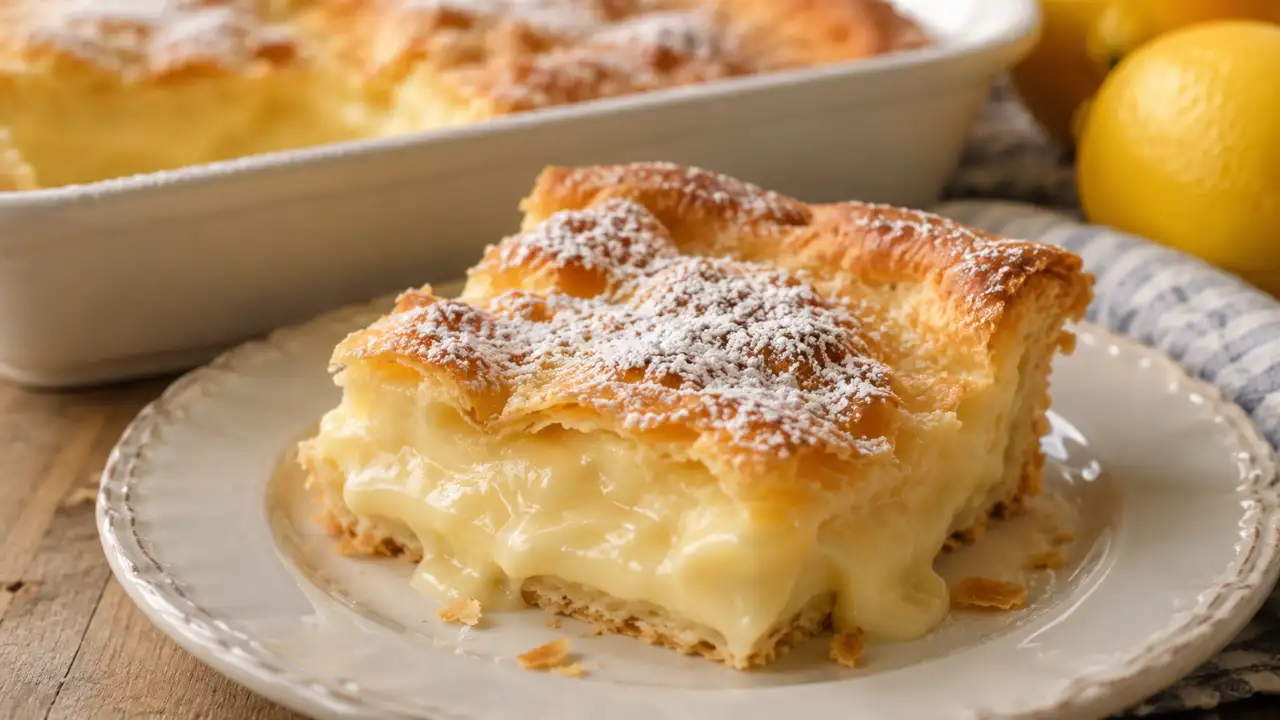
The photograph answers the question. A spoon lifted from the dish, the lemon custard clinging to it in the way that good custard always does — thick, glossy, slightly reluctant to leave. The top of the cobbler is golden and puffed and dusted in powdered sugar. The serving piece on the plate shows all three layers at the cut edge: the golden crust above, the creamy lemon center, the soft base below.
In the mouth it tastes like several things simultaneously, which is the whole point. The top is cobbler — golden, slightly textured, with the faint sweetness of the batter crust. The centre is custard — lemon-forward, silky, with a richness that comes from the pie filling settling and concentrating during the bake. The bottom is something between a sponge cake and a pudding, soft and buttery and entirely absorbed into the lemon world around it.
The lemon is the constant through all three layers. The batter carries fresh lemon juice and zest, so even the crust smells and tastes of citrus. The filling is concentrated lemon. The result is a dessert that is bright and warm and comforting simultaneously — which sounds like a contradiction and tastes like the answer to one.
Warm, with a spoon of cold whipped cream and a few fresh berries, it is a complete dessert. Served the next day, chilled from the refrigerator, the center has firmed into something closer to a chilled lemon pudding and the crust has softened pleasantly. Both versions are correct. Both are worth having.
Why the Layers Form — The Science of the Magic
Magic cakes and magic cobblers have been appearing in American recipe collections since at least the mid-twentieth century — recipes that promise a single batter producing multiple textures from one bake, and deliver on it. The mechanism is straightforward, even if the result feels mysterious.
The batter in this cobbler is denser and heavier than the lemon pie filling. When the filling is spooned over the batter in dollops and the dish goes into the oven, the heat causes the batter to rise around and through the filling rather than mixing with it. The lighter, more fluid pie filling sinks partially through the batter as the batter rises, concentrating in the center of the dish and becoming the custard layer. The batter surfaces above it, baking into the golden cobbler top. What began as two separate components stratifies in the oven heat into three distinct layers — top, center, base — each with a different texture and each related to the same original ingredients.
This is why the instruction not to stir is the most critical instruction in the recipe. Stirring the filling into the batter defeats the stratification before it can happen — you get a mixed lemon cobbler-batter hybrid rather than three distinct layers. The dollops of pie filling must sit on the batter surface, undisturbed, and the oven must do the distributing. Trust it completely. Do not stir.
What You Will Need
Serves 8 | Prep: 15 min | Bake: 45–50 min | Rest: 15 min | Total: about 1 hour 20 min
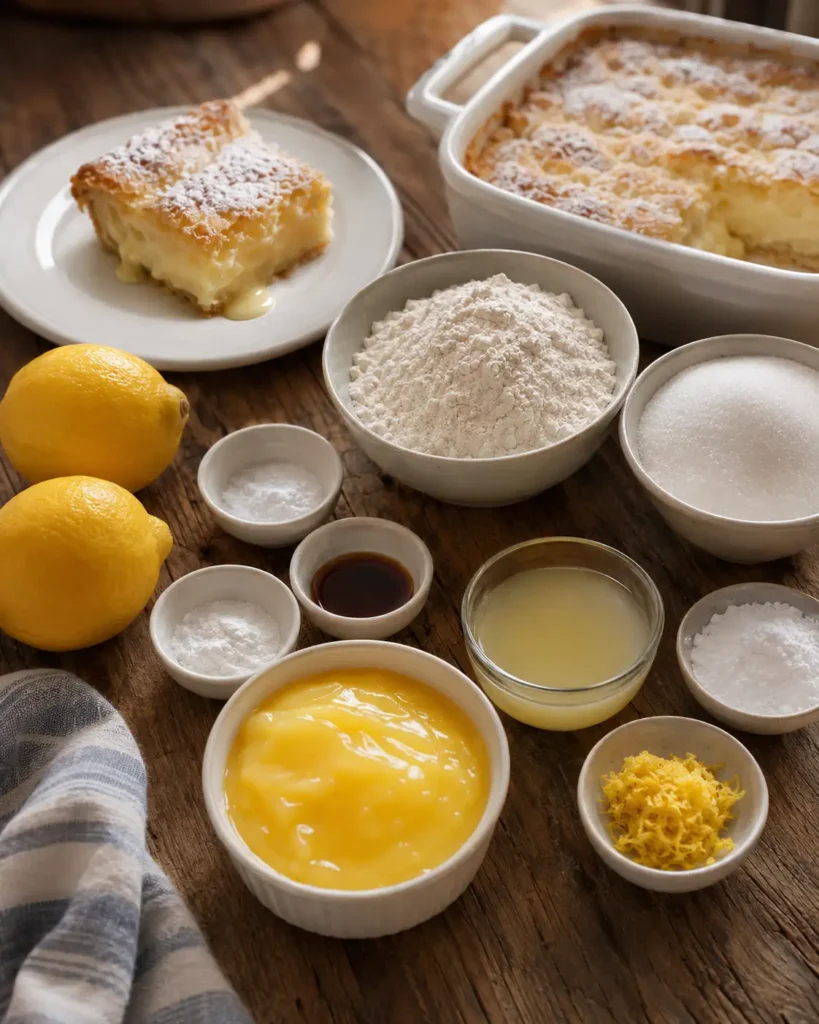
For the Cobbler Batter:
- 1/2 cup (113g) unsalted butter, melted — for mixing into the batter
- 1 cup (125g) all-purpose flour
- 1 1/2 teaspoons baking powder
- 1/4 teaspoon fine salt
- 1 cup (200g) granulated sugar
- 1 cup (240ml) whole milk
- 1 teaspoon pure vanilla extract
- 2 tablespoons fresh lemon juice — from 1 medium lemon
- 1 tablespoon fresh lemon zest — tightly packed
For the Lemon Custard Layer:
- 1 can (21 oz / 595g) lemon pie filling — or lemon curd-style pie filling
- Note: the quality of the lemon pie filling is the quality of the custard center. Use a filling you would eat on its own.
For Finishing:
- 1/4 cup (30g) powdered sugar — for dusting just before serving
To Serve:
- Freshly whipped cream — cold, lightly sweetened
- Fresh berries — raspberries, blueberries, or sliced strawberries
- A small scoop of vanilla ice cream — for the warmest, most indulgent version
- Extra lemon zest finely grated over the top — for fragrance and brightness
How to Make It
Preheat the oven to 350°F (175°C). Lightly grease a 9×9-inch baking dish or a similar-sized casserole dish with butter or cooking spray. The dish size matters — too large and the layers will be thin; too small and the cobbler will overflow. A 9×9 or equivalent is correct.
Step 1 — Make the batter.
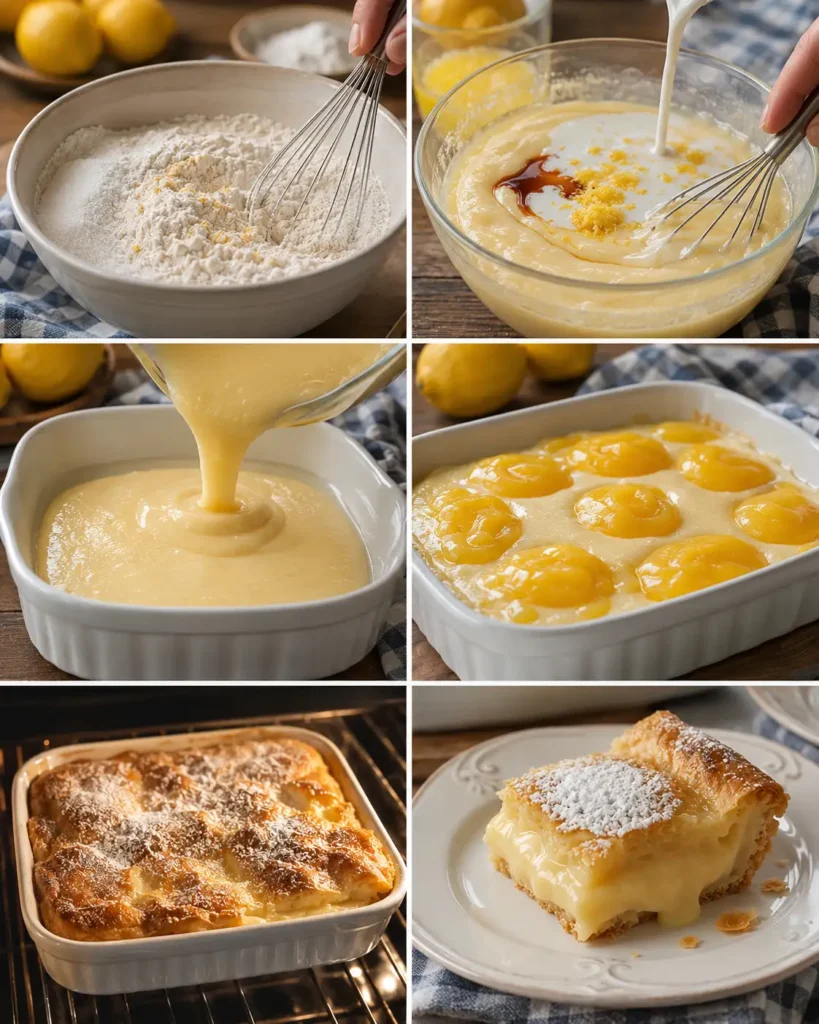
In a medium bowl, whisk together the flour, baking powder, salt, and granulated sugar until evenly combined. Add the milk, vanilla extract, fresh lemon juice, lemon zest, and melted butter. Stir until the batter is smooth and well combined — a minute of steady stirring should do it. Do not overmix beyond that point. The batter will be loose and pourable, noticeably thinner than a cake batter, with a faint yellow colour from the lemon and a fragrance that is already promising.
Step 2 — Pour the batter.
Pour the batter evenly into the prepared baking dish. Tilt the dish slightly if needed to ensure even coverage. The batter should reach the corners and lie flat — any unevenness will show in the finished cobbler’s layers.
Step 3 — Add the lemon filling. Do not stir.
Open the can of lemon pie filling. Spoon it over the batter in several generous dollops distributed across the surface — not in one central mass, but spread across the top in loose clusters. The dollops do not need to be perfectly arranged. What matters is that the filling is distributed reasonably evenly across the batter surface, and that once it is placed, you do not touch it. Do not stir. Do not swirl. Do not try to spread it into the batter. Put the spoon down. The oven takes it from here.
Step 4 — Bake.
Place the dish in the preheated oven and bake for 45 to 50 minutes. During the first twenty minutes, the surface will look somewhat chaotic — the batter rising around the lemon dollops, the filling pooling and spreading, the whole thing looking like it might not resolve into something coherent. It will. By the 35-minute mark, the batter will have risen above and around the filling and the top will be turning golden. The cobbler is done when the top is puffed and lightly golden, the edges are set and pulling slightly from the sides of the dish, and the centre still has a very slight jiggle when the dish is gently moved. The centre will firm as it rests.
Step 5 — Rest. This is not optional.
Remove the cobbler from the oven and allow it to rest on a wire rack for at least 15 minutes before serving. The rest is what allows the custard center to settle from a very soft, almost liquid consistency into the thick, creamy, spoonable custard texture that defines this dessert. Serving immediately from the oven produces a runny center. Fifteen minutes produces the texture in the photograph — thick, luscious, and holding its shape when lifted on a spoon.
Step 6 — Dust and serve.
Just before serving — never in advance, as the powdered sugar will dissolve into the surface — use a fine sieve to dust the top generously with powdered sugar. The white dusting against the golden cobbler top is both the finishing visual and the sweetness balance the cobbler needs. Serve warm, in the dish it was baked in, with a large spoon and whatever accompaniments the table calls for.
Nora’s Notes
On the lemon pie filling:
The recipe calls for one can of lemon pie filling and this is where quality matters more than anywhere else in the recipe. The filling becomes the custard center — it is the dominant flavour, the main event. Use a filling you would eat on its own with a spoon. The difference between a good lemon pie filling and a cheap one is immediately apparent in the finished cobbler: the good one produces a bright, tart, deeply lemony custard; the cheap one produces something flat and artificially sweet. Spend the extra dollar on the better can.
On fresh lemon vs. bottled juice:
Fresh lemon juice and fresh zest in the batter are not interchangeable with bottled lemon juice. The zest in particular — tightly packed, from a properly zested lemon — carries the aromatic oils that are responsible for the most vivid lemon flavour in the finished crust. Bottled lemon juice has no zest and a processed flavour that is noticeably different from fresh. One lemon provides both the juice and the zest this recipe needs. Use it.
On not stirring:
The no-stir instruction appears a second time in these notes because it is the single most important technical instruction in the recipe, and it is the one most people want to violate. The lemon filling sitting in irregular dollops on the batter surface looks wrong before it goes in the oven. It resolves into something beautiful inside the oven, over the course of forty-five minutes, entirely without your involvement. Put the spoon down. Trust the heat.
On the rest:
Fifteen minutes is the minimum. Twenty is better. The custard centre continues to set as the temperature drops, and a cobbler that rests for twenty minutes before serving produces a significantly more defined, more scoopable custard texture than one served immediately. If you are holding it for longer — for a gathering where the timing is uncertain — keep it in a low oven at 200°F covered loosely with foil. It holds well for up to 30 additional minutes.
On serving chilled:
The recipe mentions that the cobbler can be enjoyed chilled, and Nora wants to underline this. The chilled version — cold from the refrigerator the next day, dusted with a fresh layer of powdered sugar — is a different dessert. The custard centre has firmed into something closer to a set lemon pudding. The crust has softened from the refrigerator moisture into something almost cake-like. It eats beautifully cold with a spoon of crème fraîche alongside. Both temperatures are correct. Both are worth experiencing.
On the season:
Lemon is February and it is July. It is the citrus that arrives in the depths of winter and tastes of the possibility of spring, and it is the flavour that cools a summer table and makes warm evenings feel less heavy. Nora makes this cobbler in March, when the lemon trees at the market are at their most fragrant and the days are lengthening but not yet warm. She makes it in June for gatherings on the back porch. It belongs to any season that needs a bright, warm, effortless dessert — which is all of them, which is always.
Ways to Change It
Lime custard cobbler: replace the lemon juice and zest in the batter with fresh lime, and use a lime curd-style filling in place of the lemon pie filling. The lime version is sharper, more tropical, and particularly suited to summer tables. Finish with a fine grating of lime zest and a scattering of toasted coconut over the powdered sugar dusting.
Blueberry lemon cobbler: scatter one cup of fresh or frozen blueberries across the top of the lemon filling dollops before the dish goes into the oven. The blueberries sink partially into the custard layer during baking, adding a jammy berry sweetness that complements the lemon without competing with it. The finished cobbler shows blueberry pockets through the golden top where the berries have burst — it looks, and tastes, extraordinary.
Orange custard cobbler: replace the lemon juice and zest with fresh orange in the batter, and use orange curd or orange pie filling as the custard layer. The orange version is sweeter and less tart than the lemon — more gentle, more autumn-adjacent in flavour. Particularly good with a pinch of cardamom added to the batter alongside the vanilla.
Brown butter batter: melt the butter for the batter in a saucepan over medium heat, swirling until the milk solids turn golden and the butter smells nutty and caramelised — brown butter. Cool to liquid before adding to the batter. The brown butter adds a depth and nuttiness to the cobbler crust that plain melted butter cannot replicate, and it sits surprisingly beautifully alongside the bright lemon filling.
How to Serve It
- Warm from the oven after the 15-minute rest, dusted with powdered sugar, with cold whipped cream alongside — the definitive and correct presentation
- With a small scoop of vanilla ice cream placed beside the warm cobbler — the cold against the warm is the most indulgent version
- With fresh raspberries or blueberries scattered on the plate — the berry tartness alongside the lemon custard is a combination worth returning to
- Chilled from the refrigerator the following day, with a fresh dusting of powdered sugar and a spoon of cold crème fraîche — the quieter, equally rewarding version
- In the baking dish it was made in, brought directly to the table with a large serving spoon — the most honest and most Southern presentation
Storage
Cover the cooled cobbler and refrigerate for up to 3 days. The custard center firms as it chills, producing a pudding-like texture that is excellent cold with a fresh powdered sugar dusting added just before serving. Reheat individual portions gently in the microwave for 45 to 60 seconds if you prefer the warm version — it will not return to exactly its original texture, but it will be warm, soft, and very good.
This cobbler does not freeze well — the custard center separates on thawing. Make it fresh; the fifteen-minute prep time means there is no meaningful barrier to making it the same day you want it.
Why do you not stir the lemon filling into the batter in magic lemon custard cobbler?
The no-stir instruction is what creates the magic. The batter is denser than the lemon pie filling — when the filling sits on top undisturbed, it sinks through the rising batter during baking to form the custard center layer. Stirring combines the two before the oven can separate them, producing a mixed cobbler rather than three distinct layers.
What lemon filling should I use for magic lemon custard cobbler?
Use a good-quality canned lemon pie filling or lemon curd-style pie filling — one you would eat on its own. The filling becomes the custard center and is the dominant flavour of the finished cobbler. The quality difference between a good filling and a cheap one is immediately apparent in the result.
Why does magic lemon custard cobbler need to rest 15 minutes before serving?
The custard center is very soft — almost liquid — directly from the oven. The 15-minute rest allows the custard to settle and firm to the thick, spoonable consistency that defines the texture of this cobbler. Serving immediately produces a runny center; the rest produces the custard texture shown in the photograph.
Can magic lemon custard cobbler be served cold?
Yes — the cobbler is excellent chilled. The custard center firms into a pudding-like texture overnight in the refrigerator, and the crust softens pleasantly. Add a fresh dusting of powdered sugar just before serving. Both warm and cold versions are correct and worth experiencing.
Can I use fresh lemon curd instead of canned lemon pie filling?
Yes — homemade or good-quality store-bought lemon curd works well in place of canned lemon pie filling. The curd produces a slightly tangier, more intensely lemon-forward custard center. Use the same volume (about 21 oz / 2 cups) and spoon it over the batter in the same way. Do not stir.
A Recipe for the In-Between Light
Nora Beckett’s kitchen journal for March has a recurring entry: the light is changing. It means the days are getting longer without yet being warm, the citrus is at peak fragrance, and the question of what to bake is answered by whatever smells most like the possibility of a different season coming.
Magic lemon custard cobbler is that recipe for her. It smells, while it bakes, like May arriving in the middle of March — like warm afternoons and open windows and a kitchen that is bright without being hot. The lemon zest in the batter carries its aromatic oils into the air as the oven heats, and for forty-five minutes the house smells of citrus and warmth and something sweet and golden slowly becoming itself.
It is a magic recipe in the small, literal sense: the layers form themselves, the oven does the real work, and what comes out is something that required almost nothing and produced something genuinely, quietly extraordinary. This is what Seasonal Joy is always trying to find — the recipe that asks very little of the cook and gives everything to the table.
“The best moments in a kitchen are the ones where the oven does something you didn’t quite plan for — and it’s better than what you had in mind.” — Nora Beckett
More recipes tied to moments, celebrations, and the quiet pleasure of cooking with what’s fresh and alive. Follow Nora Beckett and the Seasonal Joy collection on AstroRecipes/Facebook — and never miss the recipe for the season you’re in.
Recipes I Think You’ll Love